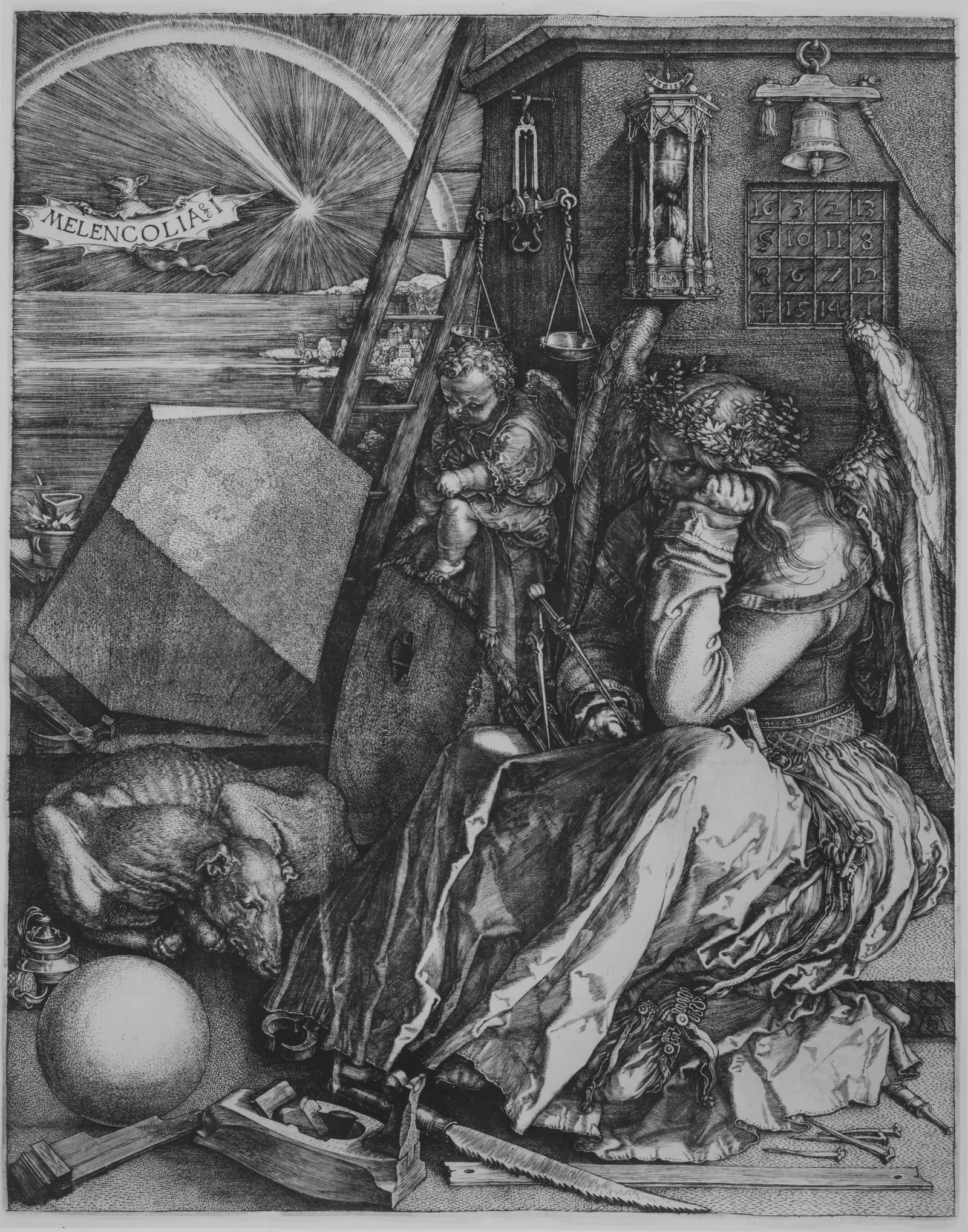
Measuring the Unsolvable: A Comparative Study of the Liber Primus (Cicada 3301) and the Voynich Manuscript
Falsification, discriminative statistics, and the limits of AI in historical cryptanalysis
Portuguese version Medindo o Insolúvel: um estudo comparativo do Liber Primus (Cicada 3301) e do Manuscrito Voynich
Matheus Soranço · Creator of I.S.A.A.C. (Intelligent Scientific Analysis & Analytics Core) · AI researcher, computer science, cryptanalysis, philosophy of mind
Preprint, not submitted to any venue. No decipherment claim is made. Code: Apache License 2.0. Paper text: CC BY 4.0. Repositories: LiberPrimus and Voynich (GitHub: Matheussoranco).
This page is the web version of the preprint, with corrections and an appendix added in November 2026; see the revision notes at the end. The PDF as originally written is kept for reference.
Abstract
The Liber Primus (Cicada 3301) and the Voynich manuscript are two of the most famous unsolved ciphertexts. Both have accumulated a century-plus of mutually incompatible “solutions,” most of them unfalsifiable. This paper reports two independent research programs, one for each artefact, that share a single methodological rule: report every statistic next to null models that ought to fail it, and bind every attack to known-answer controls drawn from the same cipher class.
For the Liber Primus, a falsification engine excludes seven cipher classes on the six unsolved sections (11,081 runes), including natural-language running keys via a convolution argument (), and documents how a substantial machine-learning search apparatus ranked a rotated plaintext above the true plaintext on an already-solved page. A subsequent variational homophonic analysis finds per-section heterogeneity: three sections compatible with homophonic English, one decisively excluded, two inconclusive.
For the Voynich manuscript, a discriminative battery tested against four structure-retaining null models shows that Zipf’s law, conditional entropy, and positional rigidity are all reproduced by an order-2 character Markov chain fitted to the manuscript’s own glyphs: they discriminate almost nothing. Two findings survive their controls: Currier A and B are distinct populations, and the line-as-a-functional-unit effect (12× glyph-level, 23× word-level divergence over a character-shuffled control) resists any substitution or transposition cipher of natural language.
The paper concludes with a discussion of where AI fits in this domain (hypothesis generation and corpus building outside the scoring loop) and where it does not (as a judge inside it).
1. Introduction
The Liber Primus is a runic codex released by the Cicada 3301 group during its 2014 puzzle round, written in a 29-character alphabet published as the Gematria Primus, mapping Elder-Futhark-derived runes to both an index and a prime value. Four sections have been decrypted by the community and read as English aphoristic and instructional text; six remain unsolved, pooling 11,081 runes. The Voynich manuscript is an illustrated codex radiocarbon-dated to the early fifteenth century (c. 1404–1438), written in an unknown script (Voynichese) across roughly 240 vellum folios. Despite more than a century of sustained professional and amateur attention, neither has been convincingly deciphered.
What unites the two domains is not just their fame but their epistemics. An unsolved artefact has no ground truth against which to check a positive claim. If a procedure outputs text that reads like English or medieval Latin, no independent oracle confirms it. The consequence is a long record of confident, mutually incompatible “solutions.” In the Voynich domain this includes work that passed peer review before being withdrawn. In the Liber Primus domain, the community has produced a sprawling registry of hypotheses with little methodological discipline.
This paper does not attempt to solve either artefact. It reports measurement programs designed so that negative results mean something. The central rule, applied mechanically in both projects, is control gating. Every attack is bound to (1) a named, size-quantified cipher class, (2) known-answer controls drawn from that same class and generated through the attack’s own primitives, and (3) a procedure applied to the real ciphertext. An attack’s report is admissible only if its controls pass; otherwise the verdict is INCONCLUSIVE, a statement about the tool, not the data.
A secondary rule is the discriminative battery: a statistic is admitted only if it separates the artefact from null models that are meaningless by construction. Null models are ordered by how much structure they retain: uniform random text, character-shuffled text, order-1 Markov, order-2 Markov. A statistic that almost everything passes cannot support a conclusion, however firmly the artefact passes it.
My personal interest in these two projects is longstanding. The Liber Primus fascination began with Cicada 3301 and turned into a personal research program combining computational cryptanalysis with machine learning. The Voynich interest is older still, a curiosity about whether statistical structure can ever establish linguistic status. Both projects are conducted as research: failures are preserved, what works is measured, and conclusions are kept smaller than the curiosity.
2. Mathematical and Cryptographic Foundations
2.1 Index of Coincidence (IC)
The index of coincidence is the probability that two symbols drawn independently from a text are identical. For alphabet size and symbol counts in a text of length :
For uniform text over symbols, . For English, . A substitution cipher preserves IC exactly (it is a bijection); a transposition preserves the unigram distribution and therefore IC; a running key convolves plaintext and key distributions, flattening but not uniformising the result unless the spectra of the two distributions are disjoint (Section 3.3 and Appendix A.2). This last fact, the convolution argument, is what allows a class-level exclusion of natural-language running keys without searching the unbounded key space.
2.2 Entropy and Conditional Entropy
Unigram entropy . First-order conditional entropy , estimated with Miller–Madow bias correction. Maximum entropy for 29 runes is bits. Low indicates sequential predictability. Entropy estimates are biased downward on short text; the correction is applied and raw values reported alongside, because an uncorrected estimator can manufacture an “unusually low entropy” finding.
2.3 Zipf’s Law
Zipf’s law: the frequency of the -th ranked item follows . A least-squares fit of log frequency against log rank yields the exponent and . Zipf compliance is true of Voynichese (, ) but is also true of an order-2 character Markov chain fitted to the manuscript’s own glyphs (, ). The statistic does not separate them; therefore Zipf compliance is not evidence that Voynichese encodes language.
2.4 Control Gating and the Verdict Lattice
Every attack carries a hypothesis, controls, and a procedure. Controls are known-answer problems from the same cipher class, generated through the attack’s own cipher primitives. The verdict lattice distinguishes REFUTED (controls passed, entire class covered, nothing found) from NOT_FOUND (controls passed, subset searched, nothing found: evidence against, not proof), CANDIDATE (controls passed, something scored in the plaintext band: referral for human review, not a solution), INCONCLUSIVE (controls failed: a statement about the tool), and UNTESTED. Controls must match the target’s scale: validating at the wrong text length proves nothing, and the dangerous direction is licensing a claim the control never tested.
3. Liber Primus: Falsification, Not Solving
3.1 What Is Being Tested
| Hypothesis | Key space | Method | Coverage | Verdict |
|---|---|---|---|---|
| Unenciphered plaintext | 1 | IC against the plaintext null (Figure 1) | Exhaustive | REFUTED |
| Affine substitution | 812 | Full enumeration | Exhaustive | REFUTED |
| General monoalphabetic substitution | IC invariant + hill-climb | Exhaustive via invariant | REFUTED | |
| Pure transposition | 161 | Full enumeration | Exhaustive | REFUTED |
| Deterministic number-theoretic keystream | 6,144 | Full enumeration | Exhaustive | REFUTED |
| Periodic Vigenère / Beaufort | up to | Exact per-coset | Exhaustive to | REFUTED |
| Running key (natural-language text) | Unbounded | Direct search + convolution IC | Partial / class-level | REFUTED |
Two exclusions are exact without enumeration. Monoalphabetic substitution has keys, but IC is invariant under any bijection on the alphabet: one measurement adjudicates all keys at once. Periodic polyalphabetic ciphers with period reduce to independent Caesar cosets; recovering the best shift per coset costs 29 evaluations each, so the full sweep to over both modes is about 106,000 evaluations (), under a second.
3.2 Null Models: Excluding Classes Without Searching Them
For each generative hypothesis, synthetic ciphertexts are simulated at the true text length () and the same statistic (IC) is measured. The observed is compared against the reference distribution. Compatibility requires both and the observation inside the range the null actually produced, because periodic nulls are right-skewed and a modest can hide an observation below every simulated draw.
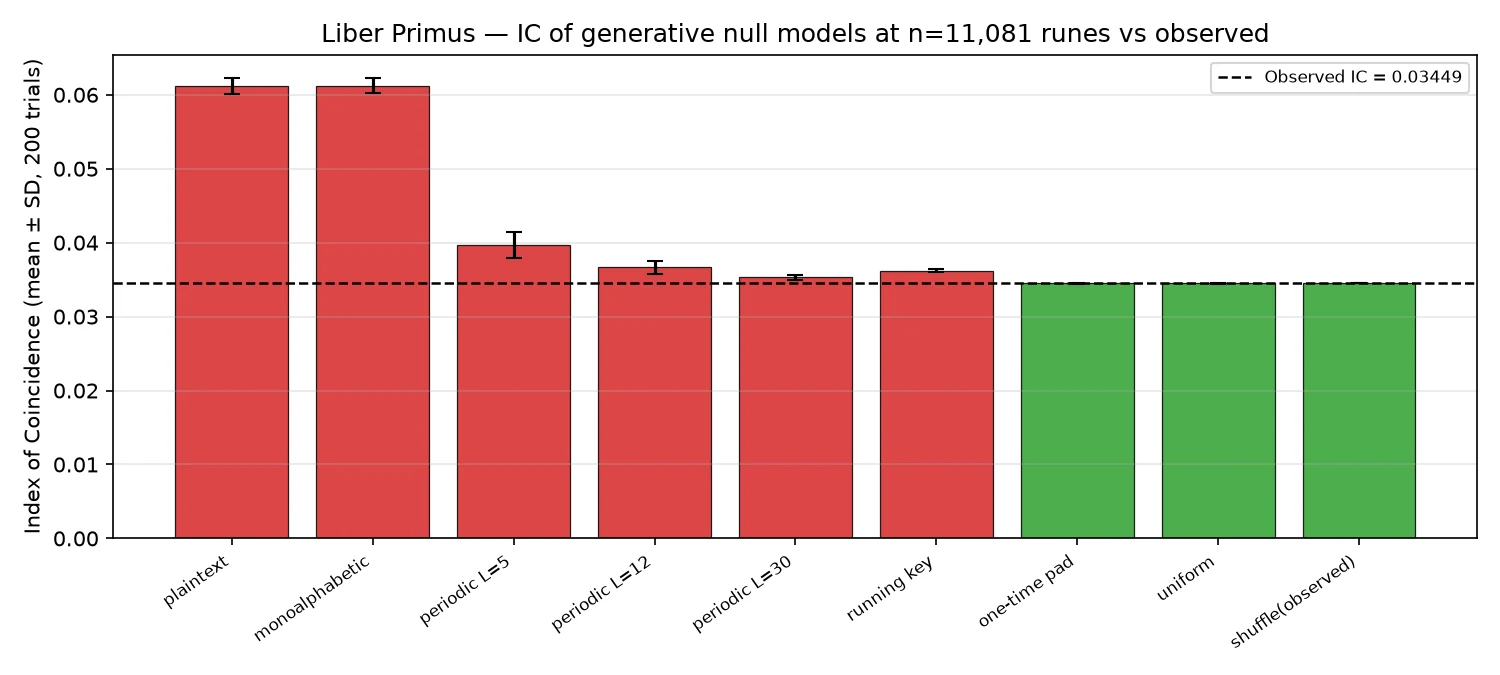
Figure 1. Index of coincidence of generative null models at runes (mean ± SD over 200 trials). The observed value (0.03449) is incompatible with plaintext, monoalphabetic, periodic, and running-key models, and compatible with one-time pad, uniform, and positional shuffle of itself.
3.3 The Running-Key Convolution Argument
A running key enciphers plaintext under a key drawn from another natural-language text. Let be the plaintext distribution and the key distribution over . Under additive combination, the ciphertext distribution is the circular convolution . In Fourier terms , and since is proportional to the squared norm of the non-constant part:
Every term is non-negative. The excess over uniform is zero if and only if, at every non-zero frequency , at least one of and vanishes. A natural-language letter distribution does not have vanishing Fourier coefficients, so convolution flattens the distribution but cannot make it uniform. The observed lies below the running-key null (; in 200 trials the statistic never fell below ).
3.4 Why the Machine-Learning Architecture Failed
The previous version of the Liber Primus codebase (~3,200 lines) implemented an island-model genetic algorithm, a MAP-Elites quality-diversity archive, CMA-ES, AlphaZero-style MCTS, a PPO agent with a Transformer actor-critic, and a neural language-model critic, all searching a composable cipher DSL. None produced a usable result.
The decisive measurement: on section 0.0 (already solved, Atbash cipher), beam search returned a cyclic rotation of the true plaintext and scored it higher than ground truth ( vs ). A cyclic rotation leaves unigrams and IC exactly invariant, and of the quadgrams survive unchanged (only the three quadgrams that straddled the cut are replaced by three that straddle the new junction), so there are near-equally-scoring decoys per genuine solution. No score can certify a decryption. The MAP-Elites archive collapsed to a single behavioural cell on real data; the RL agent controlled the operation name while the environment randomised the arguments (the entire problem for Vigenère); the COLUMNAR primitive was silently lossy while flagged invertible; and 19 tests passed because they asserted output length, not recovery.
The general lesson: more optimisation power applied to an unvalidated objective produces more confident wrong answers. For an unsolved cipher, the scarce resource is not compute, it is falsifiability. ML has a place outside the scoring loop, as hypothesis generator and corpus builder whose output a human reviews; never as a judge inside it.
3.5 Homophonic Substitution Analysis (subsequent work)
All exclusions above rely on the IC invariant or its per-coset generalisation, which apply only to bijective symbol mappings. Homophonic/nomenclator substitution, where multiple ciphertext symbols map to one plaintext letter, flattens the unigram distribution before combination and evades the IC test entirely. A variational inference attack learns a soft assignment from ciphertext runes to plaintext letters by minimising KL divergence between the decoded bigram distribution and a Gematria-normalised English reference model, calibrated against uniform-random nulls at the true text length.
| Section | Verdict | ||||
|---|---|---|---|---|---|
| 0.7 (roots) | 1.99 | 3.89 | 0.14 | −13.62 | COMPATIBLE |
| 0.8 (moebius) | 3.32 | 3.20 | 0.18 | +0.65 | INCONCLUSIVE |
| 0.9 (dots/mayfly) | 2.35 | 3.55 | 0.29 | −4.22 | COMPATIBLE |
| 0.10 (wing) | 3.41 | 4.69 | 0.28 | −4.57 | COMPATIBLE |
| 0.11 (cuneiform) | 7.96 | 4.27 | 0.15 | +24.60 | EXCLUDED |
| 0.12 (plants) | 3.32 | 4.28 | 1.12 | −0.86 | INCONCLUSIVE |
Here is the optimised objective for the section, and the mean and standard deviation of the uniform-random null, and . The verdicts follow the sign and size of : strongly negative is compatible with homophonic English, near zero is inconclusive, strongly positive is excluded.
The hard assignments collapse to a single letter for several sections, a known pathology when the signal is too weak to resolve individual mappings. Nevertheless, the -scores span . Treating the six sections as sharing one cipher, the dispersion of the -scores about their mean gives on 5 degrees of freedom, a probability below under homogeneity (Appendix A.5). The unsolved Liber Primus pages are not a homogeneous cipher; section-specific analysis is necessary, and pooled analysis is invalid for classes not closed under concatenation.
4. Voynich Manuscript: Measurement Against Nulls
4.1 Data and Null Models
Results use the ZL (Zandbergen–Landini) v3b-n IVTFF transcription: 227 pages, 5,385 loci, 37,953 word tokens, 8,423 types, 193,023 glyphs. The independent Takahashi/Interlinear (IT2a-n) transcription (225 pages, 36,907 tokens) serves as control; high-frequency word counts agree within ~1% (daiin 798 vs 805). Four null models carry no lexicon, grammar, or semantics, ordered by retained structure: uniform random + spaces; character-shuffled (preserves glyph inventory and word lengths exactly); order-1 character Markov (retains adjacent-glyph statistics); order-2 character Markov (retains two-glyph context).
4.2 Zipf’s Law Decides Nothing
Voynichese fits a rank-frequency power law with exponent 1.022 and . The order-2 Markov chain yields exponent 1.064 and : at least as Voynich-like on every axis, with no words, no meaning, and 676 states of memory. The naive “monkey” null (uniform + spaces) is distinguishable (, ), so a critique resting only on the monkey model would be weak; but the Markov chain settles it. Zipf compliance is excluded from the discriminative battery.
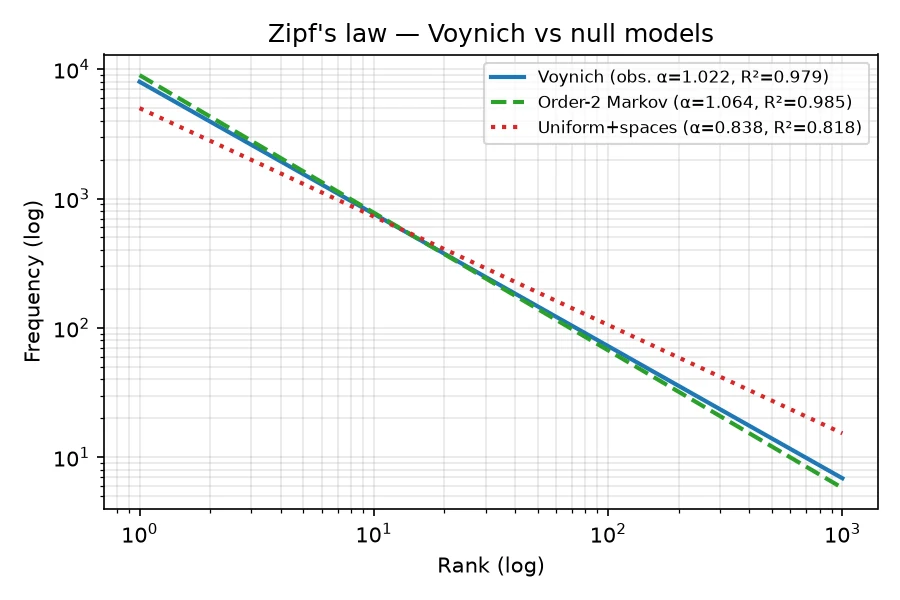
Figure 2. Zipf rank-frequency curves. Voynichese () is closely matched by an order-2 Markov chain fitted to its own glyphs (); uniform random text with spaces () is visibly different. Zipf compliance is therefore non-discriminative.
4.3 The Discriminative Battery
A battery of statistics is computed for the manuscript and all four nulls. A statistic is admitted only if it separates the manuscript from the nulls; a statistic that fails is reported as failing, which is itself a result about the literature that cites it.
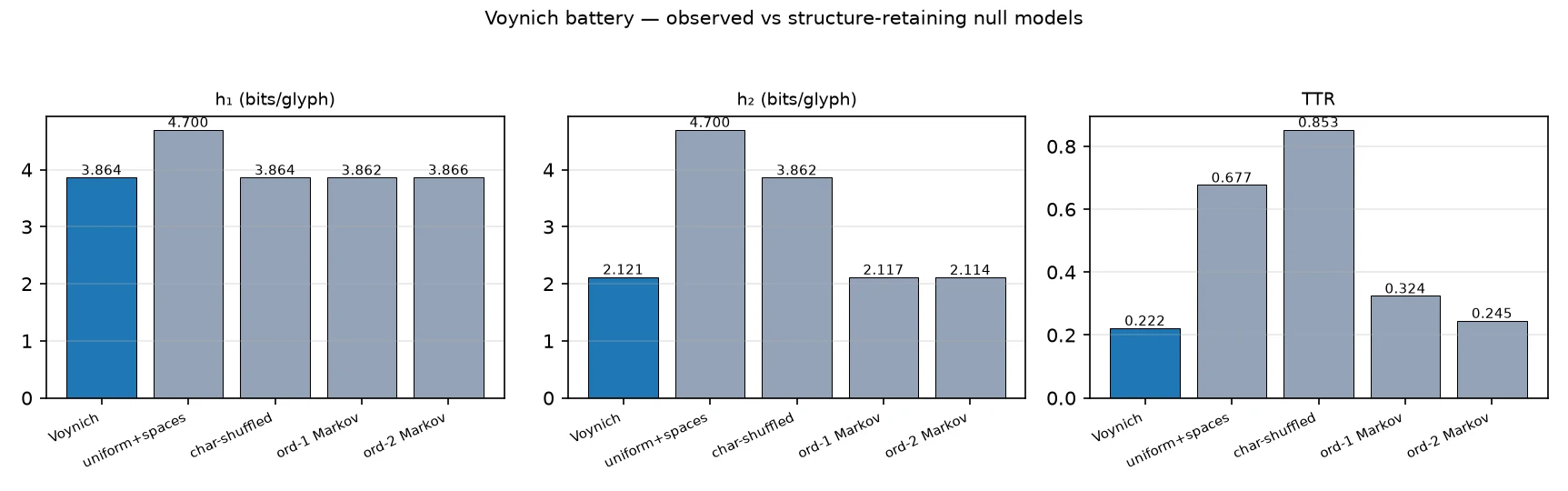
Figure 3. Discriminative battery. , , and TTR for Voynich (observed) vs structure-retaining null models. An order-1 Markov chain already reproduces , rigidity, mean word length, and adjacent repetition; only word-length variance and TTR separate them, and order-2 narrows both.
Conditional entropy bits for Voynich against 2.117 for order-1 Markov and 2.114 for order-2 Markov. The character-shuffled control at 3.862 bits shows how much predictability is real sequential structure. The correct inference is narrow: these statistics carry very little information about whether the manuscript is meaningful. Meaningful text also has low-order structure, which is why low-order statistics are weak evidence in both directions.
4.4 Two Findings That Survive
Currier A and B are distinct populations. Currier observed in 1976 that the manuscript is written in two statistically distinct systems. Measured here: A has , TTR ; B has , TTR . With 100 null trials each, the differences on , rigidity, and TTR are decisive (); word-length variance and adjacent repetition are compatible with a single process. Any account must explain both systems; any statistic over the whole manuscript silently averages two populations.
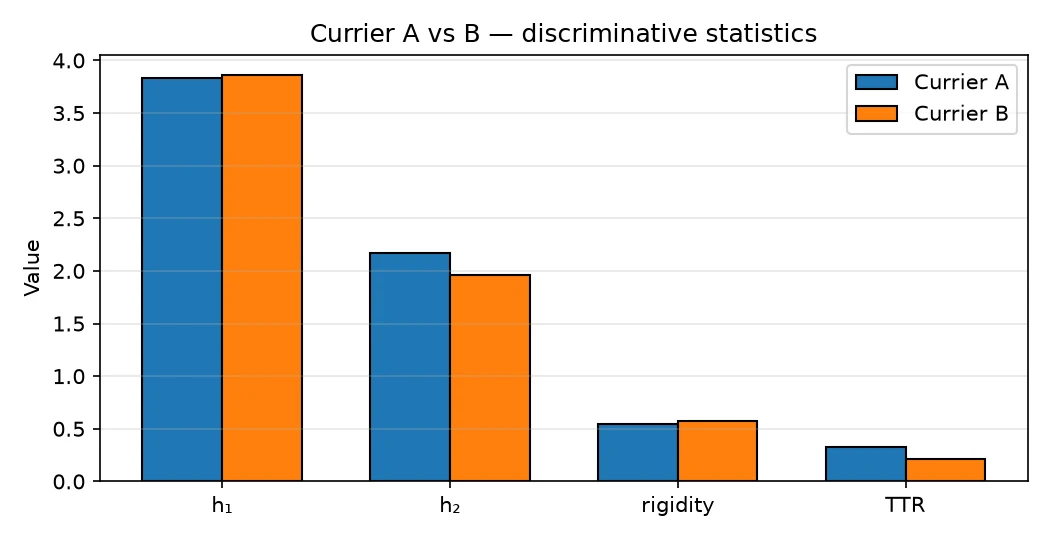
Figure 4. Currier A vs B on discriminative statistics. A and B differ decisively on , rigidity, and TTR, but not on word-length variance or adjacent repetition.
The line is a functional unit. Natural-language text does not know where the scribe will break a line. A substitution cipher acts glyph by glyph without reference to layout; a transposition permutes a stream fixed before the lines existed. Measuring the total-variation distance between the first-glyph distribution of line-initial words and all other words: for Voynich, for a character-shuffled control, a 12.3× ratio. At the word level, first-word vs , a 23.3× ratio. Paragraph-initial lines form an even more distinct subpopulation (first glyphs {p, t, k, f, o} vs mid-line {d, s, y, q, o}). This is incompatible with any substitution or transposition cipher of a natural language where the plaintext is produced independently of the page format.
4.5 Alternative Tokenisation
All statistical conclusions are conditional on the EVA tokenisation. Composite tokenisation (merging ch, sh, cth into single tokens) raises conditional entropy from 2.081 to 2.224. Merging symbols changes the alphabet, so the new value cannot be compared with the order-2 null fitted under EVA (2.114): the null has to be refitted under the same composite tokenisation before the comparison means anything (Appendix A.4). What the result does show is that the claim “Voynichese has lower conditional entropy than a 2-gram model of itself” is tokenisation-dependent and not robust. Stroke-based, first-last, and syllabic tokenisations each collapse or distort different statistics, confirming that the tokenisation choice is a modelling assumption, not a neutral formatting step.
4.6 Entropy Rate Convergence
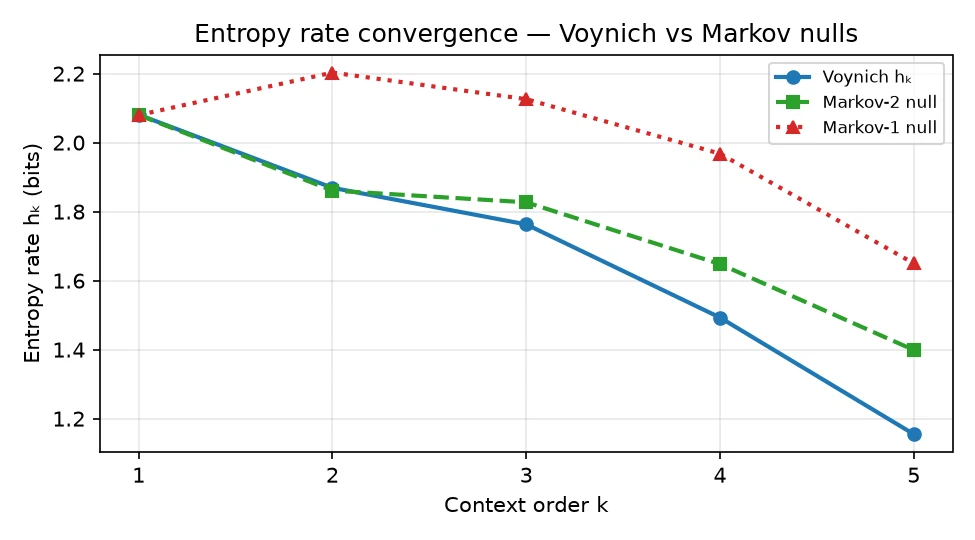
Figure 5. Entropy rate against context order . Voynich matches the order-2 Markov null at and then falls below it at , which points to dependence beyond two glyphs.
For natural language, typically converges toward ~1.0–1.5 bits/char and keeps decreasing slowly. For Voynichese, the curve coincides with the Markov-2 null at , where the null reproduces the manuscript’s low-order statistics by construction, so the agreement carries no information on its own. At the manuscript lies below the null (by roughly 0.07, 0.16 and 0.24 bits), and both curves decline partly because plug-in estimates are biased downward as the number of contexts grows toward the text length (Appendix A.3). The null is generated at the manuscript’s length and estimated the same way, so the bias is shared and the gap is not bias: the manuscript carries dependence beyond a two-glyph memory, consistent with the repeated words and word-pair patterns that the literature has long described. The entropy-rate evidence therefore supports the narrow claim of Section 4.3 (an order-2 chain reproduces the statistics of order ) and not the stronger reading that a 2-glyph-memory generative process produced the text.
5. Artificial Intelligence: What Was Tried, What Failed, What Comes Next
5.1 Approaches Tried
Both projects share an AI lineage: a dependency-free linguistic meta-learning workbench based on character 1–4-gram likelihoods, meta-trained with a first-order Reptile update across cipher/key episodes (Caesar shift, affine substitution, periodic Vigenère, plaintext autokey), evaluating fresh keys and held-out windows. The control result: untrained top-1 = 6.25%; meta-initialization top-1 = 100%; scratch + support adaptation = 100%. This is a control result, not manuscript evidence: it shows the feature learner ranks the planted answer when the correct cipher family and candidate set contain it. Scratch adaptation also reaches the ceiling, so no adaptation advantage over ordinary task-local learning is demonstrated. The workbench is deliberately isolated from the verdict lattice: learned scores can propose candidates; only controls, coverage, and independent review can support a historical-cipher claim.
5.2 What Failed
In the Liber Primus v1 codebase, the ML apparatus was not merely unhelpful but actively misleading: its objective function ranked a cyclically rotated plaintext above the true one ( vs on an already-solved page); its quality-diversity archive collapsed to one cell; its RL environment randomised the only decision that mattered; it could not recover a 3-symbol Vigenère key that exhaustive enumeration solves in under a second. In the Voynich predecessor, a “structural scorer” was fitted to a 629-character synthetic placeholder because a broken download URL fell back silently, and 21 tests passed throughout. Both failures share one structure: optimisation pressure on an unvalidated objective manufactures confident wrong answers.
5.3 Where AI Belongs
AI belongs outside the scoring loop: hypothesis generation, corpus building, orthographic normalisation, and candidate ranking whose output a human reviews and commits. AI does not belong inside the scoring loop as a judge, because a learned critic is an objective function, and Sections 3.4 and 5.2 show what happens to objective functions under optimisation pressure on unsolved ciphertexts with no ground truth. Future approaches worth trying: neural scorers as proposal mechanisms with independent statistical verification; language-model priors for homophonic assignment initialisation; transformer-based attention maps over Voynichese line structure as hypothesis generators; and controlled benchmarks where the correct answer is sometimes absent from the candidate set, to measure false-positive rates.
6. Comparative Discussion
| Dimension | Liber Primus | Voynich Manuscript |
|---|---|---|
| Ground truth | Solved pages exist; controls can be built from real plaintext | None; controls would test assumptions, not attacks |
| Core method | Control-gated falsification engine; verdict lattice | Discriminative battery against null models |
| Headline negative | Seven cipher classes excluded; running key excluded by convolution | Zipf, entropy, rigidity all reproduced by order-2 Markov |
| Headline positive | None (no decipherment) | Currier A/B distinct; line-as-unit effect (12–23× over null) |
| AI role | Failed search apparatus; later variational homophonic attack | Meta-learning control; tokenisation sensitivity analysis |
| Main limitation | Single community transcription; homophonic not closed under pooling | Single EVA tokenisation; one transcription for main results |
Both projects converge on the same methodological insight: in domains without ground truth, falsifiability and discrimination are the scarce resources, not compute or cleverness. A negative result that is trustworthy compounds; a positive result that cannot be checked does not.
7. Approaches That Can Be Tried
- Liber Primus: test homophonic substitution under non-English plaintext models (Latin, German, constructed languages); extend the convolution argument to homophonic pre-flattening; run section-specific rather than pooled attacks; investigate composite constructions (substitution → transposition → stream).
- Voynich: repeat the full battery under alternative tokenisations (completed for composites; extend to stroke/syllabic with proper controls, including nulls refitted under each tokenisation); test quire-level and hand-level splits; implement historically meaningful generative mechanisms (constrained copying, verbose cipher, abbreviation/position encoding) and measure their failure; add external domain review.
- Both: build benchmarks where the correct answer is sometimes absent; use neural scorers strictly as proposal mechanisms with statistical verification; publish null-calibrated code and data so others can replicate exclusions without repeating failed searches.
8. Conclusion
The Liber Primus unsolved pages are statistically indistinguishable from a one-time pad at , and seven cipher classes (unenciphered plaintext, monoalphabetic substitution, affine substitution, pure transposition, deterministic keystreams, periodic polyalphabetic keys to , and natural-language running keys) are excluded, each with stated coverage and assumptions. A subsequent homophonic analysis reveals per-section heterogeneity: three sections compatible, one excluded, two inconclusive, the first quantitative evidence that the unsolved pages may not be a homogeneous cipher.
Voynichese follows Zipf’s law, but so does an order-2 Markov chain fitted to its own glyphs; the argument from Zipf compliance to linguistic status does not survive contact with a null model. Conditional entropy, positional rigidity, mean word length, and adjacent repetition are all reproduced by a first-order Markov chain. Two findings survive their controls: Currier A and B are distinct populations, and the line-as-a-functional-unit effect, 12× glyph-level and 23× word-level divergence over a matched control, resists any substitution or transposition cipher of natural language.
The methodological proposal is modest and cheap: report every statistic next to null models that ought to fail it, and bind every attack to known-answer controls from the same cipher class. In a field where positive claims cannot be checked, a discipline that makes negative claims trustworthy is the only thing that compounds. Neither artefact is solved. Both are better measured.
Appendix A. Formal Results and Consistency Checks
Added in November 2026. Everything below is derived from definitions or recomputed from numbers already in the paper; it contains no new measurement on the manuscripts. Numerical statements were checked by simulation or direct computation.
A.1 The IC statistic under the uniform null, and what it can detect
For i.i.d. uniform draws over symbols, the plug-in has expectation and, to leading order,
For and this is (a Monte Carlo over 6,000 runs gives and a mean of ). The observed is therefore from the one-time-pad value; the rounding of the published four significant digits moves this by about . The statement “statistically indistinguishable from a one-time pad” is this computation.
For a periodic key of period with independent uniform shifts, pairs of positions in the same coset collide with the plaintext probability and all other pairs with on average, so
With (the plaintext bar of Figure 1) this predicts 0.0398, 0.0367 and 0.0354 for , against 0.0397, 0.0367 and 0.0354 read off Figure 1. The same formula says the aggregate IC alone separates a random periodic key from the uniform null at only while . The per-coset sweep to is therefore the exact, key-by-key complement to an aggregate test whose reach for random keys is about five times longer; periods beyond roughly 295 are not excluded by either.
A.2 The convolution identity, its exact condition, and a counterexample
Let . Parseval gives with , and for , which yields the identity of Section 3.3. A numerical check on random distributions over agrees to machine precision.
The identity gives the exact condition for a convolution to be uniform: for every , or . This is weaker than “one of the two is uniform”. For example, over take and . Both are strictly positive and visibly non-uniform, yet their convolution is exactly uniform, because their spectra live on disjoint frequencies. Natural-language distributions are not like this: their Fourier coefficients do not vanish, so the excess is strictly positive, and the simulated null of Section 3.3 supplies its size ().
One further caveat. The identity is exact for collisions between positions whose symbols are independent. Real plaintext and key texts are correlated at short lags, which changes the collision probability for pairs within a few characters of each other. Those pairs are a fraction of about of all pairs for correlation length ; with and that is under , so the bias is of order at most, an order of magnitude below the that separates the running-key null from the observation. The empirical null already contains the effect.
A.3 Estimator bias and the reach of
The Miller–Madow correction adds bits to the plug-in entropy, where is the number of occupied cells. For the 676 contexts of a bigram table on glyphs this is bits, negligible, which is why the corrected and raw agree. The number of contexts grows geometrically with the context length, by a factor of about 26 per added glyph for a 26-glyph alphabet, and passes within a few steps (). Plug-in estimates of are then dominated by the finite sample, which is why every curve in Figure 5 falls. Only the comparison between the manuscript and a null of the same length, estimated the same way, is meaningful, and that comparison is the one made in Section 4.6.
A.4 Why the composite-tokenisation comparison needs a refitted null
Entropy depends on the alphabet. Merging ch, sh, cth into single tokens replaces several symbols by one, changing both the number of symbols and the conditional distribution. A value of computed in the composite alphabet (2.224) and a null fitted in the EVA alphabet (2.114) are statistics of different random variables. The comparison is valid only against a Markov-2 chain fitted to the composite-tokenised text and sampled in the same alphabet. This is a finite computation on the same transcription and is listed under Section 7.
A.5 Heterogeneity across the six sections
If all six sections came from one cipher, their -scores would share a common value up to noise, and the statistic would follow a distribution with degrees of freedom. From the table in Section 3.5, and . The survival function of at that value is about . The -scores come from finite empirical nulls and are only approximately normal, so the exponent should not be taken literally, but no plausible departure from normality brings the probability near conventional thresholds. The recomputed for each row, , agrees with the printed value within rounding: , , , , , .
A.6 A rotation costs at most a handful of grams
Take a text of symbols and cut and rotate it at any point. For -grams, the rotated text keeps exactly of the original grams; only the grams that straddled the cut are lost and new ones appear at the junction (verified by direct count for ). For this is of . If per-gram log-probabilities lie in a range of width , the total log-likelihood of a rotation differs from that of the original by at most , and the per-gram average by at most , a quantity that vanishes as . A scorer built on such statistics cannot reliably tell a rotation from the truth on a page of any length; the observed reversal ( vs ) is the expected behaviour of the objective, not a fluke of the search.
Revision notes
Changes made to the text of the preprint for this web version (November 2026), so that readers of the original PDF can see exactly what moved:
- Abstract and Section 4.4: the glyph-level ratio is stated as 12× (the body gives 12.3×); the abstract of the PDF said 13×.
- Section 3.1: added the row “Unenciphered plaintext”, which the abstract and conclusion count among the seven excluded classes but the table omitted. Key-space entries that were unreadable in the PDF were filled from the definitions (, ).
- Sections 2.1 and 3.3: the condition for a convolution to be uniform was stated as “one of the two distributions is exactly uniform”; the exact condition is disjoint spectral support (Appendix A.2). The conclusion for natural-language keys is unchanged.
- Section 3.4: ” of quadgrams survive” is of (Appendix A.6). The figure holds for trigrams, out of .
- Section 3.5: the unreadable column header and probability bound were replaced by the definitions of , , , and by the heterogeneity statistic of Appendix A.5. The verdict convention (sign of ) is stated explicitly; it is read off the table and should be confirmed against the code.
- Section 4.5: removed the claim that composite tokenisation “moves above the order-2 null”, which compared values from different alphabets (Appendix A.4).
- Section 4.6 and Figure 5 caption: the text said the entropy rate converges toward the Markov-2 null; Figure 5 shows agreement only at and a widening gap below the null at –5. The paragraph now says that.
- Appendix A was added.
Open points for the author, not changed here: the definitions of the “pure transposition” (161 keys) and “deterministic number-theoretic keystream” (6,144 keys) classes are not given in the text; the baseline is 2.121 in Section 4.3 and 2.081 in Section 4.5 and Figure 5, and the difference is not explained; and the epigraph-style references to the companion manuscripts (2026a–d) are self-published and not linked.
References
- Friedman, W. F. (1922). The Index of Coincidence and Its Applications in Cryptography. Riverbank Publications, 22.
- Knuth, D. E. (1994). A Decryption of a Homophonic Cipher. Cryptologia, 18(3), 267–284.
- Sinkov, A. (1966). Elementary Cryptanalysis: A Mathematical Approach. Mathematical Association of America.
- Currier, P. (1976). Statistical Analysis of the Voynich Manuscript. Unpublished manuscript.
- Zandbergen, R. & Landini, G. (2020). Voynich Manuscript Transcriptions, ZL3b-n. voynich.nu.
- Soranço, M. (2026a). Liber Primus: A Falsification Engine. Self-published manuscript, 12 pp. Code: github.com/Matheussoranco/LiberPrimus.
- Soranço, M. (2026b). Voynich: Measuring the Manuscript Against Things That Mean Nothing. Self-published manuscript, 13 pp. Code: github.com/Matheussoranco/Voynich.
- Soranço, M. (2026c). Homophonic Substitution in the Liber Primus: A Variational Analysis. Self-published manuscript.
- Soranço, M. (2026d). Alternative Tokenisation and Line-Structure Analysis of the Voynich Manuscript. Self-published manuscript.
- Li, M. & Vitányi, P. (2008). An Introduction to Kolmogorov Complexity. Springer.
- Cover, T. M. & Thomas, J. A. (2006). Elements of Information Theory. Wiley.
Comments
No comments yet. Be the first to comment on “Measuring the Unsolvable: A Comparative Study of the Liber Primus (Cicada 3301) and the Voynich Manuscript”.
Sign in or create an account to like, comment and receive new texts by email.