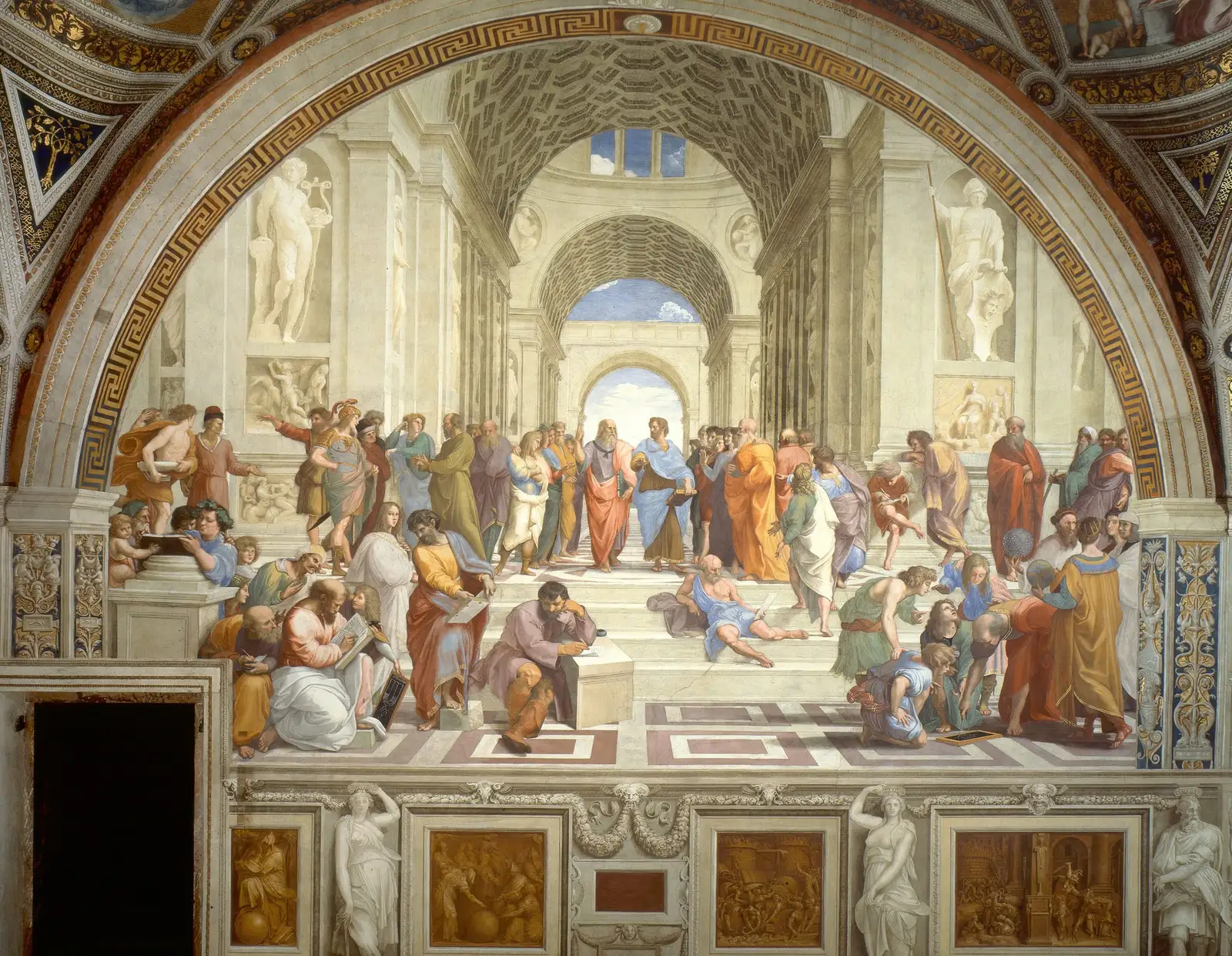
The Tyranny of the Mirror: Consciousness, Deliberation and the Necessary Suffering of Human Decisions
Translated from the Portuguese original A Tirania do Espelho: Consciência, Deliberação e o Sofrimento Necessário das Decisões Humanas
The Curse of Lucidity and the Benevolence of Instinct
“Nature made a mistake in producing consciousness.” — Peter Wessel Zapffe, Om det Tragiske
Preface: The Animal That Saw Itself
There was a moment — impossible to date, impossible to recover, but of such absolute pregnancy that the whole subsequent history of the species is nothing but a long commentary on it — when a primate raised its eyes and, instead of seeing the world, saw itself seeing the world. In that instant, something broke. Not dramatically, not with a cosmic crash, but with the silent catastrophe of a mirror forming where before there was only opaque surface. The animal became a subject. And in becoming a subject, it became that paradoxical thing we call a human being: an organism endowed with evolutionary survival mechanisms that, in perfecting themselves beyond the necessary threshold, turned against the very organism.
What this essay intends to examine is not consciousness in its totality — an enterprise too vast for any text, much less a single argument. What I intend to examine is a specific and, I believe, systematically neglected aspect of our condition: the relation between the excess of consciousness and the quality of human decisions; or, put another way, the hypothesis that conscious deliberation — that process we call “thinking before acting,” that capacity we celebrate as the highest expression of rational dignity — is, in the overwhelming majority of cases, not only ineffective but actively harmful; not only suboptimal but a generator of suffering; not only unnecessary but a betrayal of the deeper intelligence that inhabits every living being.
The central thesis can be stated thus: the decisions produced by the conscious process of deliberation are, by structure, necessarily inferior to the decisions produced by what we call the subconscious — and this inferiority is neither accidental nor correctable by more training or more information, but is intrinsic to the nature of consciousness as a biological and existential phenomenon. More than that: the characteristic suffering of human existence — emotional, psychological, relational, existential suffering — is largely the suffering produced by conscious decisions, that is, by decisions that escaped the domain of what should govern them.
To develop this argument with the seriousness it requires, we will need to pass through several layers of analysis: the neuroscience of decision, the philosophy of the will, the psychology of trauma and choice, the phenomenology of deliberation, and something we might call an ecology of desire — understanding desire not as subjective whim, but as a vector of biological and existential information of extraordinary complexity. Underlying everything will be a question that cannot be answered but that cannot be ignored either: who, after all, decides?
I. The Problem of Consciousness as Decision-Making Authority
1.1 What is a decision?
First of all, we need to be precise about what we call a decision. In a broad sense, any system with internal states that change as a function of the environment “decides” constantly: a thermostat decides to switch on when the temperature falls below a threshold; a cell decides to produce proteins when certain molecules bind to its receptors; a reflex decides to retract the limb before any signal even reaches the cortex. These are not decisions in the sense that interests us — not because they are mechanical (perhaps all decisions are), but because they do not involve the specific phenomenon we are examining: the introduction of consciousness as mediator of the process.
A human decision, in the full sense that matters to us, is an event in which a conscious subject finds itself before forks in conduct and, by means of some process — whatever it may be —, selects one of them as the one it will pursue. What distinguishes this event from a reflex or an automatic response is precisely the presence of consciousness as a mediating authority: the subject knows it is deciding, knows it could decide otherwise, and carries with it — and this is the crucial point — the responsibility for the choice made.
Now, this description, which sounds like the most obvious of descriptions, already contains a presupposition of enormous philosophical proportions: that consciousness is, in fact, the authority that decides. That when “I” deliberate consciously about which path to take, it is “I” — this conscious, reflective self, capable of articulating reasons and weighing consequences — who genuinely produces the decision.
This presupposition, as we will see, is probably false. And its falsity has devastating consequences not only for our self-understanding but for our capacity to conduct life with some degree of internal harmony.
1.2 The Illusion of Authorship: What Neuroscience Tells Us (and What It Hides from Us)
In 1983, the neurophysiologist Benjamin Libet carried out an experiment that shook the foundations of the philosophy of action and that, curiously, was absorbed by popular culture much more as a curiosity than as a catastrophe. The experiment was simple: subjects were to flex their wrist whenever they wished, while watching a special clock that allowed them to mark the moment at which they became aware of the “will” to move the wrist. Meanwhile, electrodes recorded the brain’s electrical activity.
The result was as follows: the brain began to prepare the movement — the so-called “readiness potential” was detectable — about 550 milliseconds before the movement. Awareness of the intention to move arose about 200 milliseconds before the movement. But the readiness potential preceded the awareness of intention by almost 350 milliseconds.
Conclusion: the decision had already been made — by the brain, by the nervous system, by some authority that was not the conscious self — before consciousness even knew there would be a decision. What we call “conscious will” arrived, at most, in time to veto the movement (something Libet also documented: consciousness can inhibit, but does not seem to initiate). But the initiative — the creative spark that set the process in motion — was not its own.
Subsequent experiments, with more sophisticated methodologies and much longer lead times, confirmed and extended this finding. In 2008, John-Dylan Haynes and collaborators showed that activity in certain regions of the prefrontal and parietal cortex could predict with significant accuracy which hand a subject would use to press a button up to 10 seconds before the subject reported the conscious intention to do so. Ten seconds. The entire universe of conscious deliberation — all the tiny eternity we feel ourselves living when we “make” a decision — takes place within a window that the brain had already determined well in advance of any reasonable planning.
But here we need to be careful about interpretation. The hasty conclusion would be: “therefore free will does not exist, everything is determined, consciousness is an epiphenomenon.” This conclusion, although perhaps correct, is not what interests us here. What interests us is a more specific and, philosophically, more fertile conclusion: consciousness, as an authority of decision, is not only not the origin of choices, but is, in many cases, an authority that arrives afterward and narrates the decision as if it had made it. It is an authority of rationalization, not of effective deliberation.
And it is here that suffering begins to appear on the horizon.
1.3 The Narrator Who Arrived Late
Imagine an experienced jazz musician improvising on stage. Their fingers move over the keys with a speed and precision that no conscious process could govern in real time. Each note is a decision — a decision made in fractions of a millisecond by a system that has accumulated decades of patterns, of musical memory, of response to what the other musicians are doing, of harmonic intuition that does not let itself be articulated in words. If you ask the musician, after the show, why they played that note there, they will probably have an answer — but that answer will be a story, not a cause. The note has already sounded. The “reason” was constructed afterward.
Now imagine that, in the middle of the improvisation, this musician begins to think consciously about each note. They begin to deliberate: “should I go to F sharp or to G? What scale am I using? What is the harmonic relation to what the bassist just played?” The result is immediate and catastrophic: the flow breaks, the fingers stumble, the music loses the life it had. The musician has gone from creator to analyst, and in doing so has become incompetent at the task they performed magnificently a second before.
This phenomenon has a name in cognitive psychology: “paralysis by analysis” in its mild form; “choking” in its severe form, especially studied in the sports context. But what it reveals is something much more fundamental than a performance phenomenon: it reveals that consciousness and competence are, in many domains, inversely related. That the interval between intention and action, when filled by deliberating consciousness, is often an interval of degradation.
The subconscious — and I use this term in the broad sense of “all cognitive, emotional, bodily and historical processes that operate below the threshold of explicit consciousness” — is a decision mechanism of extraordinary sophistication. It integrates information that the conscious process simply lacks the capacity to process in parallel: the microexpressions of the interlocutor’s face, the tension in one’s own body, the emotional resonance of the memory of analogous situations, the statistical patterns absorbed through thousands of experiences, the state of the autonomic nervous system as a sensor of the environment. All this happens simultaneously, effortlessly, without words.
Consciousness, by contrast, is serial and narrow. It processes one thing at a time. It works with linguistic or quasi-linguistic representations. It has a famously limited window of attention. And it has, moreover, a specific and serious defect: it knows that it knows. That is: it is aware of its own processes, and this — far from being a universal advantage — is frequently a source of distortion, anxiety and error.
II. The Anatomy of Conscious Suffering
2.1 When Consciousness Invades the Domain of Instinct
There is a territory of decisions in which consciousness simply should not operate, and its invasion of that territory is almost always disastrous. This territory includes: how to breathe, how to walk, how to sleep, how to relate sexually, how to eat when hungry, how to cry when sad. These are domains in which the body knows what to do with a perfection that no conscious instruction could improve — and that any conscious instruction tends to worsen.
Insomnia is perhaps the purest example of this invasion. Sleeping is the most natural thing in the world: a healthy organism, fatigued, in an adequate environment, sleeps. The subconscious knows this. The body knows this. The homeostasis of the nervous system knows this. But when consciousness installs itself in the process — when the subject begins to think “I need to sleep,” “why am I not sleeping?,” “if I don’t sleep I won’t have energy tomorrow,” “I’m failing even at sleeping” — the wakefulness that should last seconds stretches into hours. The very conscious monitoring of the process of falling asleep prevents the process from occurring, because falling asleep requires exactly what consciousness cannot give: absence of monitoring.
The same applies, in varied ways, to any process that should be governed by the subconscious but that consciousness hijacks. A child learns to walk without significant verbal instruction; put an adult to thinking consciously about how to distribute their weight, and they stumble. The experienced swimmer swims with a style their body has learned and that no analysis would improve; tell them to think about each movement, and the coordination comes undone. The gastronome who eats to feel pleasure finds it; the gastronome who eats while consciously monitoring their experience of pleasure loses contact with the very pleasure they were trying to capture.
There is a name for this phenomenon in Zen Buddhism: mushin — “mind without mind” — is the state of flow in which action and agent become indistinct, in which self-consciousness dissolves and competence emerges in its purest form. The same phenomenon was described by Mihaly Csikszentmihalyi as flow, and by so many others in so many traditions. What all these descriptions have in common is the recognition that there exists a quality of presence and effectiveness that reflective consciousness not only fails to produce, but systematically prevents.
But the damage is not limited to effectiveness. The damage extends, and here we arrive at the heart of the argument, to the domain of suffering.
2.2 The Genesis of Conscious Emotional Suffering
Zapffe, in his extraordinary “The Tragic Human Being,” argues that human consciousness is a biologically oversized phenomenon — that it was developed beyond what survival requires, and that this excess is the root of all specifically human suffering, the suffering that has no parallel in the animal kingdom. Animals suffer physical pain. Animals suffer deprivation. But animals do not suffer from existential anguish, from retroactive shame, from anticipatory anxiety, from remorse, from regret, from paralysis before freedom.
All these sufferings — which constitute the majority of human psychological suffering — are sufferings produced by consciousness. More specifically: they are sufferings produced by consciousness turning back on its own decision processes and beginning to audit, to question, to reconstruct counterfactually what might have been different.
Take remorse as an exemplary case. Remorse is the suffering of a decision made that we cannot undo, but that consciousness insists on re-examining, reformulating, condemning. From the adaptive standpoint — from the standpoint of what would be useful to the organism — remorse has value only as an instruction for the future: it serves to avoid repeating the same mistake. Once that learning has been done, remorse has no further function; it is pure cost, pure erosion. But consciousness does not work this way. Consciousness, once it has taken possession of a past decision, tends not to let go of it. It re-examines it not in order to learn, but out of a kind of structural compulsion that seems intrinsic to the nature of reflective thought: the inability to accept the irreversible as irreversible.
This is a point of enormous importance. The subconscious lives entirely in the present. It integrates information from the past — uses it as data, as structural memory — but does not inhabit the past. It does not counterfactually reconstruct what might have been different. It does not condemn the organism for decisions the organism made with the information it had available. The subconscious is, in this sense, radically pragmatic: the past informed the present; the present is what it is; the immediate future is what is to be navigated.
Consciousness, by contrast, is an inhabitant of time in a way that no other cognitive mechanism is. It can live in the past with a disturbing fidelity, recreating dead situations in detail that makes the pain as fresh as at the moment it occurred. It can live in the future with an anticipation that produces sufferings from events that may never happen. And in doing so — in inhabiting time so comprehensively — it multiplies suffering by a factor that no animal experiences: the factor of the temporal ubiquity of suffering itself.
2.3 Anxiety as a Specific Product of Conscious Deliberation
Anxiety, in its clinical and existential sense, is the suffering produced by the anticipation of an uncertain future before which the subject does not feel adequate. It is the suffering of consciousness projecting ahead, calculating probabilities of threat, constructing catastrophe scenarios, and then inhabiting these imaginary scenarios with an affective intensity that the body does not distinguish from real threats.
What is remarkable about anxiety, from the standpoint of our argument, is that it is almost exclusively a product of conscious deliberation. The non-anxious animal — the animal that acts from instinct — does not project itself forward in the way that produces anxiety; it responds to present danger with a mobilization proportional to the real danger. The human being, by contrast, can produce the whole physiological arsenal of the stress response — cortisol, adrenaline, tachycardia, hyperventilation — in response to entirely imaginary dangers that consciousness constructed in deliberating about the future.
It is crucial to understand that anxiety is not a malfunction — it is not a consciousness that works badly. It is consciousness functioning exactly as its nature is to function: projecting, calculating, anticipating, evaluating. The problem is not in a malfunction; it is in the nature of the mechanism. The consciousness that anticipates produces suffering not as a side effect, but as a direct product of its functioning.
And here we arrive at a particularly important dimension of the argument: the relation between conscious deliberation and the decisions that produce the greatest human suffering.
III. The Conscious Decision as a Mechanism of Betrayal
3.1 The Case of Relational Decisions
There is no domain in which the damage of conscious deliberation is clearer — and more devastating — than the domain of human relationships. Love, friendship, trust, care: all these are states that arise, develop and operate according to a logic that consciousness does not govern and that, when it tries to govern, it invariably damages.
No one consciously decides to love someone. The statement may sound banal, but its implications are enormous. The process we call “falling in love” is entirely subconscious: it is the integration of an enormous quantity of information — appearance, voice, smell, behavior, memories of earlier affective experiences, hormonal state, social context, momentary vulnerability, and countless other variables — into an affective signal that consciousness merely receives, does not produce. When consciousness tries to reproduce this process — when someone rationally decides that they should love a certain person because she combines the desirable qualities — the result is invariably an affective pathology. It is the marriage of convenience that produces resentment. It is the relationship built on rational foundations that collapses when real affects emerge in another direction.
But the damage of consciousness is not limited to the initial phase of the relationship. It deepens, in various ways, throughout the entire duration of the relationship.
Consider what happens when a couple faces a serious conflict. There are two possible processes: the subconscious process, which manifests as immediate emotional reaction — anger, hurt, fear, longing — and the conscious process, which manifests as deliberation: “what should I say? How should I behave? What are my rights here? What are the possible consequences?” The subconscious process, however uncomfortable, carries genuine information about the state of the relationship and of the organism. The conscious process, with all its appearance of rationality, tends to produce a mixture of strategic self-defense, simplifying narratives, and judgments that protect the ego but distort the reality of the relationship.
The psychology of relationships, at this point, is quite clear: the couples who function best over time are not necessarily those who communicate most verbally or who deliberate most about the problems of the relationship. They are those who have developed a kind of subconscious relational intelligence — a mutual sensitivity, a capacity of response that operates below the level of verbal articulation, a continual adjustment that does not pass through reflective consciousness. John Gottman, whose research on marriage is perhaps the most extensive and methodologically solid in the field, showed that he can predict the dissolution of a marriage with high accuracy from micro-behavioral patterns that the spouses themselves do not consciously perceive — which implies, symmetrically, that what preserves a relationship also operates largely below the threshold of consciousness.
The paradox is that the more a relationship becomes the object of conscious analysis, the more its participants deliberate about it, the more often it deteriorates. Not because analysis is useless in all contexts — it has a role at specific moments — but because the constant presence of consciousness as an evaluating authority of the relationship introduces a distance between the participants and the very experience of the relationship. To be constantly assessing whether you are happy in a relationship is precisely the best way not to be happy in it.
3.2 The Paradox of Choice and the Suffering of Multiplicity
Barry Schwartz, in The Paradox of Choice, documented a phenomenon that, in our language, can be described like this: an excess of options activates the conscious process of deliberation to a level that produces suffering, regret and dissatisfaction that would simply not exist if the options were more limited or if the decision were made by another mechanism.
The classic experiment is the jam experiment: consumers presented with a selection of six flavors buy more than consumers presented with a selection of twenty-four. The abundance of options does not maximize satisfaction; it paralyzes the decision process and, when the decision is finally made, it generates a residual dissatisfaction — the shadow of all the options not chosen — that simply does not exist when the options are few.
What this phenomenon reveals is that conscious deliberation is not merely a mechanism that sometimes fails; it is a mechanism that scales badly. The more material it receives — the more options, the more variables, the more time to deliberate — the more it tends to produce suffering, not less. Because the conscious process of deliberation has a property that no subconscious mechanism has: it does not stop. It continues after the decision has been made. It continues to evaluate the alternatives that were rejected. It continues to construct the counterfactual of what might have been different. And it therefore continues to produce suffering long after any adaptive function has been fulfilled.
The subconscious, by contrast, when it produces a decision, produces it with a completeness that consciousness rarely achieves. The child who chooses the chocolate ice cream does not spend the afternoon wondering whether she should have chosen vanilla. The animal that chose the territory to the north produces no retrospective anxiety about the territory to the south. The decision was made; the organism moves on. It is only consciousness that refuses to move on, that insists on inhabiting the space of unrealized possibilities with a fidelity that is, ultimately, a form of torture.
3.3 Free Will as Necessary Fiction and Structural Poison
We arrive here at the most delicate and most important point of the argument: the question of free will.
The hypothesis I propose is not simply that free will does not exist — that is a legitimate philosophical position but one that, on its own, does not produce the consequences that interest me. The hypothesis is more specific: free will, as subjective experience, as the sensation of deliberate authorship over one’s own choices, is a fiction that consciousness produces after the decisions are made — and it is precisely this fiction that is the source of enormous human suffering.
When consciousness attributes to itself the authorship of a decision that was in fact made by deeper processes, it also assumes total responsibility for that decision and for all its consequences. Guilt, remorse, shame: all these sufferings presuppose that the subject could have done otherwise, that the decision was genuinely free in the sense that the opposite was equally possible. But if the decision was, in the terms we described above, the product of neural processes that preceded awareness of the intention by seconds or more, then the “blame” for the decision does not belong to the conscious self — it belongs to a set of forces — genetic, historical, neurochemical, contextual — that the conscious self did not choose and could not have modified at the moment of decision.
The problem is not so much metaphysical as functional: even if free will does not exist as ontological reality, it exists as phenomenological experience. And as long as it exists as phenomenological experience, it will produce all the moral and emotional consequences that follow from the belief in authorship. The subject who “freely” chose the wrong path — the destructive relationship, the career that was not theirs, the word that hurt — will carry the weight of this choice with an intensity that no deterministic explanation relieves.
Zapffe understood this when he described the mechanisms of repression by which human beings try to protect themselves from the excess of consciousness: isolation (restricting conscious content), anchoring (fixing values and beliefs that cannot be questioned), distraction (avoiding the contemplation of emptiness), and sublimation (transforming anguish into cultural production). What all these mechanisms have in common is that they are defensive strategies against consciousness itself — attempts to limit the damage that consciousness inflicts on the organism that hosts it.
But if consciousness needs to be suppressed, restricted, defended against, in order for the organism to function with some degree of peace — then it is, structurally, something to be managed and not celebrated. It is a wound that needs dressing, not a talent that needs unrestricted exercise.
IV. The Subconscious as Superior Intelligence
4.1 The Wisdom of the Body
There is an intellectual tradition — running from Spinoza to Nietzsche, from Wilhelm Reich to António Damásio — that insists that the body knows more than the conscious mind. Not in a mystical way, but in an entirely material one: the body has accumulated, through billions of years of evolution and decades of individual experience, an intelligence that no conscious deliberative process could replicate.
Damásio demonstrated, with his studies of patients with damage to the ventromedial prefrontal cortex, that the capacity to make good decisions depends critically on the integrity of the emotional systems — not because emotions are more “rational” than conscious thought, but because emotions are the means by which the body communicates to the cognitive system information that would otherwise be inaccessible. Patients who retained intact cognitive capacities but had lost access to emotional signaling became unable to make adequate practical decisions. They knew everything rationally, but could not choose. They were paralyzed before alternatives, or made choices that were objectively harmful to them.
What this reveals is that emotions — which are, for the most part, subconscious processes communicated to consciousness as bodily states — are not noise in the decision process. They are the most fundamental signal. They are the organism’s voice about what is good for it, filtered by millennia of natural selection and by the whole of individual life experience. When we ignore this signal — when conscious deliberation superimposes its own categories, criteria and calculations on the emotional signal — we often do exactly what the organism knows we should not do.
4.2 Intuition as Distributed Computation
The concept of intuition has undergone a significant intellectual rehabilitation in recent decades — not as a mystical phenomenon, but as a cognitive one: the emergent product of pattern-recognition processes that operate below the threshold of consciousness and that use information consciousness could not process explicitly.
Gary Klein, studying the decision-making of experienced firefighters, found that they rarely deliberate consciously in the conventional sense — they rarely build lists of pros and cons, rarely evaluate alternatives systematically. What they do instead is recognize patterns: the current situation resonates with earlier situations stored in memory, and this resonance produces an action that is immediate, decisive and often correct. Consciousness then narrates this action — “I decided to do X because Y” — but the narrative is partly retrospective. The decision had already been made by subconscious pattern recognition.
The same phenomenon has been documented in chess masters (who “see” the right move before analyzing it), in experienced physicians (whose intuitive diagnoses often outperform diagnoses produced by explicit analytic protocols), in successful investors (whose best decisions often contradict formal analyses), and in countless other domains of expertise.
The common denominator is that intuition is neither arbitrary nor irrational: it is the product of massive, distributed, parallel processing that consciousness simply cannot do. It is high-dimensional computation to which consciousness — with its serial and narrow nature — has no direct access. When consciousness tries to superimpose its own processing on intuitive processing, it often degrades the final result.
4.3 The Body as Oracle: Somatic Knowledge
There is an even more fundamental level of subconscious intelligence that is rarely recognized as such: somatic knowledge — the knowledge the body has about itself, about the immediate environment, about the state of relationships, which is communicated not through propositions or images but through physical sensations.
The sensation of a “tight stomach” before an important decision. The relaxation the body experiences in the presence of certain people and the tension it experiences in the presence of others. The fatigue it feels when asked to do something that violates its nature. The energy that arises when it is on the path that belongs to it. All these are information — not metaphors, not fantasies, not illusions — they are outputs of processing systems that integrate more variables than any consciousness could articulate.
The problem is that modernity, and especially rationalist-Enlightenment modernity in its most exacerbated form, has trained human beings to systematically distrust this information. The modern project of rationalization, in its most radical version, is a project of suppressing the bodily in favor of the abstract, the instinctive in favor of the deliberate, the felt in favor of the calculated. And the result — which psychological clinics see every day, in its multiple forms — is a humanity that made rationally impeccable decisions that made it profoundly unhappy, because the decisions were made on wrong information, on the belief that conscious calculation had access to all the relevant variables, when in fact it systematically ignored the most important ones.
V. The Specific Pathology of the Excessively Conscious Decision
5.1 The Case of Career Choice
No decision reveals more clearly the suffering produced by excessive conscious deliberation than career choice — especially in contemporary societies, where the multiplicity of options combines with the ideology of self-realization to create a pressure on this decision process that earlier generations simply did not experience.
The young person who chooses a career through an entirely conscious process — researching markets, calculating financial returns, evaluating social prestige, consulting rankings, reading testimonials — and who ignores (or does not know how to listen to) what their subconscious knows about what gives them pleasure, what gives them energy, what makes time pass without their noticing, what makes them feel alive when they practice it — this young person is building a gilded prison. They are using the most sophisticated mechanism available to make the worst possible decision.
The irony is that the criteria that conscious deliberation uses to evaluate a career — income, stability, prestige, alignment with measurable cognitive abilities — are precisely the criteria that have the least correlation with long-term satisfaction at work. The criteria that correlate most with satisfaction — the sense of purpose, the state of flow, the sense of belonging to a practice that has value in itself, the resonance between the work and the deepest identity — are precisely the criteria that conscious deliberation has the greatest difficulty evaluating, because they are criteria that operate at the subconscious level.
The result is an epidemic of professional dissatisfaction that statistics document with frightening regularity: the majority of workers in practically all developed countries report significant degrees of disengagement from their work. This is not a failure of the labor market. It is a failure of the decision mechanism by which people arrive at the work they do.
5.2 Self-Sabotage as the Logic of Consciousness
There is a phenomenon that clinical psychologists know well and that popular motivation theory often misinterprets: self-sabotage. The individual who, repeatedly, when about to achieve something they consciously desire, does something that compromises that achievement. The student who stops studying two days before the decisive exam. The entrepreneur who makes a bad decision precisely when the project is about to succeed. The writer who destroys the nearly finished manuscript.
The most common interpretation is that these people “don’t really want” what they say they want — that they have some fear of success, some unconscious belief that they do not deserve it, some unresolved conflict with the authority figure that achievement would represent. This interpretation may be correct in some cases. But there is another possible interpretation, which our argument suggests: that the subconscious, in these situations, has a different assessment from consciousness of what is good for the organism, and that what we call “self-sabotage” is in fact an assertion — clumsy, poorly articulated, destructive in form — of a wisdom that consciousness did not want to hear.
The student who sabotages the exam may be communicating, in the only way they know how, that they do not genuinely want the career for which the exam is the entrance — and that this truth was systematically suppressed by the conscious deliberation that weighed the advantages and concluded that this career was “the right decision.” The entrepreneur who sabotages the project may be expressing an exhaustion that consciousness refused to acknowledge because the narrative of success was more comfortable. The writer who destroys the manuscript may be acting on an intuition about the quality of the work that consciousness — too committed to the self-image of a writer — could not directly accommodate.
“Self-sabotage,” on this reading, is a subconscious that communicates through the only language consciousness cannot ignore: consequence. When the organism speaks and nobody listens, it acts. And the action is disastrous not because the subconscious is destructive, but because the communication was forced to pass through an inadequate channel — surprise action instead of gradual perception — because of consciousness’s resistance to receiving messages that contradict its plans.
5.3 The Suffering of Indecision: Consciousness in a Loop
There is a form of suffering that is perhaps the purest expression of what I am describing: chronic indecision. The state in which deliberating consciousness cannot produce a decision, and the organism is left suspended in a kind of limbo — knowing it needs to act, unable to act, consuming energy in a process that does not advance.
Indecision is not a lack of information. Most chronically indecisive people have access to all the information that would be needed for a reasonable decision. The problem is not in the quantity of data available; it is in the nature of the process trying to process them. Consciousness, applied to decisions of high emotional value, tends to enter a loop: each deliberative cycle produces new considerations that make the decision more complex rather than simpler, and the subject is caught in a process that has no internal criterion of termination.
The subconscious, in these situations, often already knows. It already knows what it wants, already knows what it fears, has already made its decision at the level at which decisions are really made. What consciousness is doing, in these long periods of indecision, is not deliberating toward a conclusion: it is resisting the conclusion that the subconscious has already reached, because that conclusion contradicts some belief, some explicit value, some image of the self that consciousness needs to protect.
The suffering of indecision is, therefore, not the suffering of not knowing — it is the suffering of knowing and not wanting to know. It is the suffering produced by consciousness’s resistance to the intelligence of the organism itself.
VI. The Existential Dimension: Zapffe and the Weight of Self-Transparency
6.1 The Tragedy of the Conscious Species
Zapffe starts from a premise that deserves to be taken seriously in all its brutality: the human being is a biologically maladapted organism, not in the sense that it lacks cognitive capacity, but in the sense that it has cognitive capacity in excess — a consciousness that far exceeds what would be necessary for survival and reproduction, and that for this reason turns on itself and on the world with an intensity that is pure excess.
This superconsciousness has a specific property that matters to us here: it makes the human being the only animal capable of understanding its own mortality, its own cosmic insignificance, its own existential arbitrariness. And this understanding — which is, note, a perfectly lucid, perfectly correct understanding — is in itself a source of suffering without parallel in the animal kingdom.
But Zapffe’s argument is not limited to death and the cosmos. It includes the banal, everyday suffering that results from a consciousness that functions all the time at full capacity, that processes everything, that does not rest, that cannot stop seeing what it sees. It is this incessant functioning of consciousness that makes sleep an absolute necessity — not only the sleep of the body, but the sleep of consciousness, the temporary suppression of the reflective apparatus that makes life possible.
Applying this perspective to the problem of decisions: consciousness, when applied to a decision, cannot simply calculate and conclude. It sees everything. It sees the present decision, but also sees its irreversibility, its contingency (it could have been otherwise), its inscription in a causal chain that goes back to the beginning of the universe and which therefore cannot be attributed to any individual agency, its relation to the mortality of the subject who decides (each decision is also the exclusion of all the other possibilities that would have been possible in the life being lived), and so on. Conscious deliberation, taken to the limit, is not simply slow or imprecise: it is paralyzing, because its object is not only the immediate practical question — it is the totality of existence that each practical question summons.
6.2 Anguish as Structure, Not as Accident
Kierkegaard described anguish as “the dizziness of freedom” — the vertigo that arises when the subject realizes that it is free, that it could have done otherwise, that what is had no necessity to be. This dizziness is not an error of perception; it is the correct perception of the human condition. Anguish, in Kierkegaard, is not a pathology to be treated but a structure of conscious existence to be traversed.
What I propose goes beyond Kierkegaard: anguish is not only a structure of conscious existence in general — it is the specific structure that emerges when consciousness tries to govern the decision process. Because every conscious decision is, at once, the affirmation of one possibility and the negation of all the others; and a sufficiently developed consciousness cannot do this without feeling, to some degree, the weight of all the possibilities being negated. Anguish is not the fear of any specific thing — it is the suffering of the pure possibility that each decision obliterates.
And here is the cruel elegance of the problem: the consciousness that produces anguish in deciding also produces anguish in not deciding. Indecision is not a refuge from anguish; it is a different way of inhabiting it. The subject who decides is anguished by what they have lost; the subject who does not decide is anguished by what they are not doing. Consciousness has no exit within itself.
The exit — if there is an exit — lies outside consciousness. It lies in the return, partial and provisional, to the mode of functioning that evolution produced before consciousness existed: the mode in which the organism acts, not the one in which the subject deliberates.
6.3 Schopenhauer and the Intellect as Insubordinate Servant
Arthur Schopenhauer provides, in The World as Will and Representation, one of the clearest articulations of what contemporary neuroscience would confirm by other means: the intellect — consciousness, reason — is not the foundation of being; it is a late elaboration, a tool, a servant that the Will (the blind and irresistible substrate that governs all existence) produced for practical purposes of orientation in the world. When the servant forgets it is a servant and tries to become master — when the intellect tries to govern the Will instead of serving it — the result is disorder and suffering.
In the language we are using: consciousness should be an auxiliary instrument of the subconscious, not a substitute for it. It should articulate, communicate, refine and implement what the subconscious has produced — not replace the process of production. When it tries to replace it, it does so with an instrument whose capacities are fundamentally inadequate to the task, and the result is necessarily inferior to what the original process would have produced.
Lévi-Strauss’s “savage mind,” Polanyi’s “tacit knowledge,” Aristotle’s “practical wisdom,” Goleman’s “emotional intelligence,” Ryle’s knowing how in contrast with knowing that: all these notions, from diverse traditions and disciplines, point in the same direction — there exists a mode of knowledge and action that is not propositional, not articulable in language, not the product of conscious deliberation, and that is, in many fundamental contexts, superior to propositional knowledge and deliberate action. Modernity, in its one-sided emphasis on the latter, has systematically depreciated the former — and has paid, and continues to pay, an enormous price in that operation.
VI-B. The Perverse Temporality of Deliberating Consciousness
6.4 The Imaginary Future as Factory of Suffering
There is a temporal asymmetry that cannot be sufficiently underlined: the subconscious exists fundamentally in the present; consciousness exists fundamentally in projection. This asymmetry is not contingent — it is not a habit we could modify by discipline or practice — it is constitutive of the nature of consciousness as a phenomenon. Consciousness is, in its essence, the apparatus that projects the present beyond itself: that reconstructs the past and anticipates the future as objects of reflection. Without this capacity, it would not be consciousness in the full sense; it would be mere registering. It is the act of projecting — of taking what is and imagining what could be or what could have been — that defines the phenomenon.
This projection is, on the scale of evolutionary adaptation, an extraordinary advantage. The ability to anticipate future dangers allowed Homo sapiens to plan, prepare, build shelters before the cold seasons, store food before the droughts, organize defenses before the attacks. No other animal possesses this capacity to a comparable degree. And it is undeniable that it was, and continues to be, the basis of all the technical and cultural development of the species.
But this same advantage becomes, in the domain of emotional and existential decisions, a source of unprecedented suffering. Because projection does not discriminate between real physical threats and imaginary existential threats. The same mechanism that anticipates the storm anticipates failure. The same apparatus that plans the hunt plans social humiliation. The same system that builds the shelter builds, with equal diligence and equal affective intensity, scenarios of abandonment, irrelevance, death.
And here is the structural cruelty: the subconscious responds to real threats. Consciousness responds also to imaginary threats. The lion on the savanna and the lion that consciousness is constructing in thought are, for the autonomic nervous system, equally real. The stress response is the same; the muscle tension is the same; the hormonal cascade is the same. Except that the real lion eventually goes away or eats you — in both cases, the situation resolves. The imaginary lion never goes away, because it is made of the same substance that makes it: thought. And thought can always generate more thought. The suffering produced by the imaginary lion can last for decades.
Every important decision that consciousness deliberates contains, within it, a population of imaginary lions: the possible failures, the possible losses, the possible judgments of others, the possible regrets of oneself. And consciousness, in the act of deliberating, inhabits them with a completeness that the subconscious — which would merely respond to what is present — would never produce. It is consciousness, therefore, and not the subconscious, that is the primary factory of the anticipated suffering that accompanies every significant decision.
6.5 Retrospective Remorse: The Consciousness That Does Not Release the Dead
Just as consciousness inhabits the future with its imaginary lions, it inhabits the past with its unburied dead. Remorse — and its variants: guilt, shame, regret — is the suffering produced by past decisions that consciousness refuses to declare closed.
From the standpoint of the subconscious, a past decision whose consequences have already played out is information — information that updates patterns of future response. But the past itself is not inhabited; it happened, its data were incorporated, one moves on. The subconscious does not hold a grudge against itself. It does not reconstruct, with revisionist anguish, what it should have done otherwise. It learns and moves on.
Consciousness does not know how to do this. It knows it could have done differently — because it understands the contingency of its own choices, because it can imagine counterfactually what would have happened had it chosen otherwise. And this knowing is, at once, its cognitive grandeur and its specific torment. To know that something could have been different but was not, and that now it cannot be redone: this is the basic structure of remorse, and it is impossible without the reflective consciousness that understands contingency and irreversibility simultaneously.
The painful paradox is that the more developed consciousness is — the more sophisticated, the more capable of imagining alternatives, the more endowed with perspective on its own past — the more intensely it can inhabit remorse. It is not the less reflective person who suffers most from remorse; it is the most reflective. Because it is the most reflective who can reconstruct the past with greater fidelity and greater richness of detail, who can imagine most vividly what life would have been on the other path.
Consciousness transforms the past into a permanent present. And this permanent present of the past is one of the most efficient mechanisms of suffering that evolution, unintentionally, produced.
6.6 Social Comparison as a Product of Deliberating Consciousness
There is a specific mechanism of suffering that is almost entirely a product of conscious deliberation and that is rarely analyzed as such: social comparison. The process by which a subject evaluates their own achievements, choices, appearance and quality of life in relation to those of other subjects — and which produces, invariably, both vanity and envy, both pride and the inferiority complex.
The subconscious does not compare in the relevant sense. It registers differences of status, responds to social hierarchies with adaptive behaviors (like every primate), feels the pain of exclusion and the pleasure of belonging. But it does not construct comparative narratives that turn one’s own life into a continuous evaluation against the lives of others. This narrative construction is a product of consciousness — especially of the consciousness that developed in late modernity, potentiated by devices that make visible, in real time and on a global scale, the curated appearance of other people’s lives.
Conscious social comparison is a form of deliberation about one’s own worth — a deliberation that, by its structure, cannot produce stable satisfaction. Because the criterion of comparison is infinitely expandable: any standard that seems satisfactory reveals, on closer examination, a population still more prosperous, more attractive, more fulfilled, relative to which the comparison restarts. And because the “choices” that brought us to where we are — and which social comparison implicitly evaluates — are precisely the kind of decision that, as we have argued, was produced by the wrong process, with the wrong criteria, and which therefore already contains in its structure the seeds of the regret that social comparison fertilizes.
VII. Objections and Replies
7.1 “But Instinctive Errors Are Catastrophic”
The most obvious objection to the argument I have developed is: if conscious deliberation is so problematic, how do we explain the immense errors that instincts and automatic reactions produce? Are the cognitive biases documented by Kahneman and Tversky — confirmation bias, the availability heuristic, the framing effect — not all errors of the fast and automatic system that the slow and deliberate system needs to correct?
This objection is legitimate and requires a precise answer. My thesis is not that the subconscious is infallible or that consciousness has no role at all. My thesis is more specific: that consciousness is misused as the primary authority of decision, especially in domains of high emotional value, and that this misuse produces specific suffering that would not be produced if consciousness were used in the role that suits it.
The appropriate role of consciousness is not to produce decisions; it is reflection on systemic patterns. It is useful — indispensable, even — for identifying that a pattern of behavior is consistently producing bad results. It is useful for building heuristics that modify the environment so that subsequent automatic responses are better. It is useful for communicating intentions to other conscious subjects, for coordinating collective action, for the explicit learning of new domains. What is not useful — what is actively harmful — is applying consciousness to the immediate process of decision in domains where the subconscious has more complete information and a more adequate process.
Kahneman, whose critique of “System 1” (the automatic) in favor of “System 2” (the deliberative) is often cited, is more nuanced than his popularizations suggest. He explicitly recognizes that the superiority of System 2 is contextual and that, in many domains, the attempt to replace intuition with analysis produces worse results. The problem is not in having two systems; it is in not knowing when to use each — and modernity, culturally, has an enormous and systematically harmful bias toward System 2.
7.2 “Deliberation Prevents Harm to Others”
A second important objection: conscious deliberation plays a fundamental role in the control of destructive impulses. Without the capacity for conscious reflection, the human being would be subject to acting on impulses of anger, jealousy, fear, which would produce harm to themselves and others. The father who is furious with his son acts better when he can think before reacting; the citizen who feels hostility toward a group acts better when he can reflect on the origins of that feeling.
This objection is also genuine and also requires a precise answer. What it describes is a specific function of consciousness that is valuable and that no serious argument would reject: the inhibitory function. Consciousness, as Libet had already suggested, can veto actions that the subconscious has initiated — and this veto is, in many cases, socially and individually beneficial.
But there is an important difference between consciousness as an authority of veto and consciousness as an authority of production. The father who is furious with his son benefits from a moment of pause that consciousness provides — not to decide the response, but to prevent the first automatic response (which may be destructive) from being carried out before the subconscious has processed the situation more fully. After this pause, when the subconscious system has more time to integrate the complete situation — the love for the son, the wider context of the behavior, the memory of analogous situations — the response that emerges is often better than the first and also better than anything strict conscious deliberation could produce.
The problem is not using consciousness to pause and inhibit. The problem is using consciousness to replace the subconscious process in producing responses. These are qualitatively different uses, with qualitatively different results.
7.3 “This Is Dangerous Irrationalism”
There is a third kind of objection, more philosophical: the concern that the argument I have developed is a form of irrationalism that, taken to its consequences, could justify anything in the name of “instinct” or the “subconscious.” This is a serious objection that deserves to be taken seriously.
The argument is not irrationalist in the relevant sense. I am not saying that reason has no value, that analysis is useless, that we should abandon the Enlightenment project of thinking rigorously about the world. I am saying something more specific: that reason has a legitimate domain of application, and that when it invades domains that do not belong to it, it does harm.
Reason is excellent at: understanding formal structures, building causal explanations, developing scientific knowledge, coordinating social action on a large scale, identifying logical inconsistencies, designing technical systems. Reason is terrible at: deciding whom to love, determining what makes the organism flourish, evaluating in real time situations of high emotional complexity, producing affective states of well-being, integrating the totality of information relevant to decisions of high dimensionality.
Dangerous irrationalism is not the recognition of these limits. Dangerous irrationalism is the pretension that reason has no limits — that any problem can and should be solved by conscious deliberation, and that the resistance of the body, of the affects, of instinct to this deliberation is simply an obstacle to be overcome. This is the position that produced, in the twentieth century, some of the most terrible demonstrations of what happens when reason instrumentalizes the subconscious instead of listening to it: the architectures of rational-bureaucratic power that Bauman analyzed in Modernity and the Holocaust are the extreme product of a technical-rational consciousness that suppressed all the subconscious processes of empathy, hesitation, horror, and replaced them with procedures, hierarchies and efficiency.
Listening to the subconscious is not irrationalism. It is, paradoxically, the epistemically most honest position: the one that recognizes that there are forms of knowledge that exceed propositional articulation and that are, in their domains, more reliable than what the conscious process can produce.
VIII. Implications: What to Do With This
8.1 The Impossibility of Return
It would be tempting, at this point, to conclude with a simple prescription: “listen more to your subconscious, deliberate less.” But this prescription is itself a trap — because it is a conscious deliberation about how to use conscious deliberation less. It is consciousness instructing itself to step back, which is contradictory at the same level as the paradoxical instruction “don’t think of white elephants.”
Zapffe understood this. There is no return to the pre-conscious state. Consciousness, once it exists, exists. It cannot be switched off by instruction, cannot be suppressed by decision. The mechanisms Zapffe described — isolation, anchoring, distraction, sublimation — are precisely this: mechanisms for managing the excess of consciousness, not for eliminating it. They are strategies of coexistence with a phenomenon that cannot be reversed.
What can be done — and this is less than most would like to hear, but perhaps it is enough — is an ecology of consciousness. A practice, individual and cultural, of recognizing when consciousness is operating in its domain and when it is invading foreign domains; of cultivating listening to the subconscious without necessarily turning this listening into a new project of rational management; of creating the conditions under which the subconscious process can operate with less interference.
8.2 Practices of Non-Interference
The contemplative traditions of all cultures can be reread, from this perspective, as traditions of conscious non-interference: practices that temporarily suspend the deliberative process to allow other processes to operate. Meditation is not, fundamentally, a practice of thinking better; it is a practice of interfering less. What experienced practitioners report is not an increase in deliberative capacity, but a decrease in the intrusion of consciousness into processes that would function better without it.
The automatic writing of the Surrealists, the stream of consciousness as a literary technique (which is, paradoxically, a stream of the subconscious), the practices of improvisation in theater and music, tai chi and other internal martial arts, contemplative prayer: all these practices, in their enormous differences, share the element of suspending conscious deliberation as a precondition for a kind of access that deliberation would block.
From the standpoint of practical decisions, the implication is not to despise analysis but to order it correctly in time. There is a kind of process that consists of: gathering information consciously, processing the formal dimensions of the problem consciously, and then stopping conscious deliberation and letting the subconscious integrate. The “solution that comes in the shower,” the insight that appears on waking, the clarity that arises after a period of rest: these are neither miracles nor luck. They are the subconscious, finally free of conscious interference, carrying out the integration that consciousness had prevented with its incessant activity.
8.3 Suffering as Signal, Not as Failure
One of the most important consequences of the argument I have developed is a reinterpretation of the emotional and psychological suffering produced by decisions. If the suffering of a decision is, in many cases, the suffering of having ignored the subconscious — of having done what conscious analysis prescribed instead of what the organism knew it should do — then this suffering is not merely pain: it is information.
It is the clearest signal the subconscious has for communicating to consciousness that something is wrong. And a consciousness that learns to read this signal — instead of trying to suppress it, anesthetize it, or rationally explain it until it seems tolerable — is finally using its reflective capacity in its correct role: not as a producer of decisions, but as an interpreter of the signals the organism produces.
The suffering that results from a conscious decision that contradicts the subconscious should not be treated as a failure of the subject, as emotional weakness, as irrationality to be overcome. It should be treated as evidence that the decision was made by the wrong mechanism. It is the organism saying: “You asked me afterward. Next time, ask beforehand.”
8.4 The Re-education of Listening: Culture, Clinic and Practice
There is a practical dimension that this argument, if honest with itself, cannot avoid. If excessive conscious deliberation is structurally a generator of suffering, and if there is no pure return to the pre-conscious state, what remains is a practice of re-education — not of consciousness, which already exists and cannot be undone, but of the relationship between consciousness and the processes that precede it.
This re-education has, in contemporary clinical psychology, some of its most rigorous expressions. Emotion-Focused Therapy, developed by Leslie Greenberg, starts precisely from the premise that affects — products for the most part of subconscious processes — are carriers of adaptive information that the conscious process frequently suppresses or distorts. The therapeutic aim is not to make the patient more rational, but more capable of listening to what their affective system is communicating and of distinguishing between affects that are genuine information and affects that are crystallized defensive patterns.
Sensorimotor Psychotherapy, developed by Pat Ogden, goes deeper: it works with the bodily memory of traumatic experiences — memory that is stored in the nervous system below the linguistic level and that purely verbal therapy often does not reach. The premise is that the body knows, and that the therapeutic work is to create conditions for this knowing to manifest, not for consciousness to replace it with a more adaptive narrative.
What these approaches have in common — and what distinguishes them from the purely cognitive approaches that still dominate much clinical practice — is the recognition that human suffering is not primarily a problem of incorrect thinking to be corrected by more correct thinking. It is a problem of relationship with one’s own internal processes: a relationship in which consciousness frequently tyrannizes instead of listening, controls instead of flowing, deliberates when it should trust.
This point has implications that exceed the clinic and reach pedagogy, the philosophy of education, the formation of organizational and political cultures. A culture that teaches its members to systematically distrust their own intuitive and affective processes, to always rationally justify each choice, to treat emotion as an obstacle to good decision — such a culture is systematically manufacturing the conditions for the kind of suffering this essay describes.
A different culture — one that taught listening before deliberating, inhabiting uncertainty without prematurely resolving it into analysis, trusting what the body communicates as a starting point and not as an obstacle to overcome — would produce not only people more satisfied with their decisions, but wiser people. Not in the sense of accumulating more conscious information, but in the sense of being more in touch with the intelligence they already possess and that the overculture of systematic deliberation has systematically silenced.
8.5 The Political Dimension of Excessive Consciousness: The Subject Who Cannot Choose Without Justifying Themselves
There is a political dimension that this argument touches and that cannot be completely ignored: the demand for rational justification of choices as a mechanism of social control.
Modern societies, in their liberal and non-liberal forms, share a fundamental assumption: that the legitimacy of an action depends on the subject’s ability to articulate rationally their reasons for it. The law demands stated motivation. Bureaucracy demands documentation of process. The modern market demands that the consumer be able to explain why they chose this product and not that one. Pedagogy demands that the student be able to justify each answer.
This demand for rational justification is not neutral. It selects, as legitimated behavior, precisely the behavior that passed through the conscious-deliberative mechanism — and delegitimizes or renders invisible behavior that arose from subconscious processes, however wise and well-founded. The manager who made the right decision intuitively is less legitimate, in the bureaucratic structure, than the manager who made the wrong decision with a documented analytic process. The judge who sensed that the testimony was false and whose intuition was correct is formally less trustworthy than the judge who followed the protocol and was deceived.
This mechanism has the consequence of training subjects to make decisions by the wrong process — not because the wrong process produces better results, but because it is the only process whose outputs have the right form to be communicated and legitimated in the social structure. And by training subjects to make decisions by the wrong process, the social mechanism systematically deepens the suffering this essay describes.
It is a bitter irony: the same culture that celebrates consciousness and deliberation as supreme values is, for that very reason, a particularly efficient culture in the production of the sufferings that excessive consciousness generates. It not only fails to protect its members from this suffering; it intensifies it, institutionalizing it.
IX. The Horizon of the Problem: Science, Culture and the Future of Decision
9.1 The Culture of Conscious Decision
What makes this problem especially urgent is not only its individual dimension, but its cultural dimension. We live in a civilization that systematically privileges conscious deliberation as the legitimate and valued way of making decisions. Educational systems teach thinking, not feeling — and when they teach “using emotional intelligence,” they often do so by converting affects into objects of rational analysis, which is a sophisticated way of perpetuating the same problem.
The labor market rewards the ability to rationally articulate the basis of each decision — which means rewarding not necessarily the best decisions, but the most rationally justifiable decisions, which are often different things. Medicine, for decades, privileged the analytic protocol over experienced clinical intuition — and there is considerable evidence that this preference produced both diagnostic errors and worse care. The law builds ever more elaborate systems of conscious deliberation for decisions that, in their most important dimensions, exceed what any deliberative system can capture.
The cultural result is a civilization of people increasingly skilled at articulating reasons and increasingly unskilled at making good decisions. Increasingly capable of constructing narratives for their choices and increasingly incapable of making choices that make them happy. This is not an accidental paradox — it is the systemic consequence of a cultural project that elected deliberative consciousness as the ideal of human rationality, ignoring that human rationality has forms that exceed and precede conscious deliberation.
9.2 Artificial Intelligence and the Amplified Mirror
It is not possible, at this moment in history, to ignore the relationship between this argument and the development of artificial intelligence. The AI systems that today make decisions in countless domains — from medicine to law, from credit to public health — are, in a sense, the project of conscious deliberation taken to the limit: they are the attempt to make the decision process entirely explicit, entirely articulable, entirely calculable.
And the results are, in certain domains, impressive. In well-defined domains, with clear success criteria and quantifiable information, AI systems consistently outperform human deliberation. But in domains of high emotional, contextual and relational complexity — precisely the domains where the suffering of bad decisions is most acute — AI systems reveal the same defects as human conscious deliberation, amplified: they process the variables that can be formally represented and ignore the variables that cannot, with often disastrous consequences.
What AI lacks — what no deliberative system has — is what only the living organism, with its evolutionary history and embodied experience, possesses: the sensation of living in the skin of the consequences. The human subconscious is what it is precisely because the organism that hosts it is mortal, vulnerable, dependent on others, inscribed in a history of suffering and pleasure accumulated over billions of years. This inscription is irreproducible by any system that does not share this fundamental vulnerability.
9.3 The Problem of Trauma and the Memory That Has Not Passed
There is a dimension of the argument that needs to be treated separately, for it introduces a crucial complication: trauma. Because trauma is, precisely, the case in which the subconscious too has failed — in which the nervous system was exposed to an experience that exceeded its capacity for integration, and that was stored not as processed memory, but as fragmented, dissociated memory, reactivated in inappropriate contexts.
Trauma is the case in which the subconscious itself began to produce maladaptive responses: the panic reaction to an innocuous stimulus, the affective dissociation in situations of intimacy, the defensive aggressiveness in contexts of safety. And here it would be tempting to conclude that, in these cases, consciousness is necessary to correct the errant subconscious.
But there is a crucial nuance that the psychology of trauma has learned, the hard way, in recent decades: the purely cognitive approach to trauma — the attempt to treat traumatic memory through narration and conscious analysis — is often insufficient and sometimes counterproductive. It can produce retraumatization, can crystallize narratives that imprison the subject in a victim identity, can create intellectual distance from an experience that needs to be processed at a level deeper than the linguistic.
What the most effective approaches to trauma have demonstrated — EMDR, Somatic Experiencing, approaches based on sensorimotor processing — is that healing occurs not when consciousness understands the trauma, but when the nervous system processes what it could not process at the moment of occurrence. That is: healing occurs when the subconscious resumes its natural function of integrating and archiving, a function that the trauma itself had interrupted. Consciousness has a role as a safe witness of this process — as a presence that can observe without being dragged along — but not as the primary operator of the transformation.
Trauma, therefore, does not refute the argument of this essay: it confirms it in its most difficult version. Even when the subconscious is producing inadequate responses, the solution is not to replace it with deliberating consciousness, but to create conditions for it to resume its own integrative capacity. Consciousness trying to repair a traumatized subconscious by analysis is like a surgeon trying to operate on a patient in shock by the method of verbal deliberation. The instrument is legitimate in other contexts; here, it is the wrong one.
9.4 Nietzsche and the Body That Knows
No Western thinker formulated more clearly than Nietzsche the central thesis this essay develops, and it would be dishonest not to acknowledge it explicitly. In Thus Spoke Zarathustra and in the preparatory notes collected in The Will to Power, Nietzsche repeatedly articulates a position that can be summarized thus: the body is a great reason, while the conscious self is only a small reason — an instrument of the body, not its ruler.
The Nietzschean argument is that the subject’s deepest identity is not in the conscious self but in the bodily-subconscious process that precedes and sustains it. The conscious self — the “small reason” — is derivative, is an instrument, is a late elaboration of a more fundamental process. And pathology arises precisely when this “small reason” forgets that it is an instrument and tries to become ruler — when the conscious self begins to dictate to the body instead of listening to it, when conscious morality begins to deny impulses instead of channeling them, when reflective thought begins to condemn life instead of serving it.
What Nietzsche calls ressentiment — and which is perhaps his most singular contribution to psychology and moral philosophy — is precisely a state produced by consciousness turned against its own vital substrate: the consciousness that, unable to realize its desires, transforms impotence into virtue and frustrated desire into moral judgment. Ressentiment is the suffering of a consciousness that has lost contact with what the body wanted and built, on this loss, a philosophy of negation that presents itself as moral elevation.
Nietzsche is, at this point, an unacknowledged predecessor of the psychology of health that would come decades later: the idea that the denial of one’s own vital processes — however much it presents itself as discipline, asceticism or virtue — produces not spiritual elevation but psychic illness is today not merely a philosophical hypothesis but a hypothesis with extensive clinical support.
9.5 The Question Neuroscience Cannot Answer
There would be a temptation — especially in an essay that relies on evidence from neuroscience — to conclude that the solution to the problem of excessive consciousness is scientific in nature: if we better understand how the brain works, if we map in more detail the neural circuits of decision, if we develop evidence-based protocols for when to use each type of cognitive process, we will have solved the problem.
This temptation must be resisted. Not because neuroscience is irrelevant — it is, as we have seen, fundamentally illuminating — but because the problem this essay describes is not primarily a problem of cognitive engineering. It is a problem of being. It is the problem of a type of organism that has become capable of seeing itself, and does not know what to do with this vision.
Neuroscience can tell us how consciousness works. It cannot tell us what to do with the fact that it works this way. This is a philosophical and existential problem that no amount of neural data can resolve — not because the data are insufficient, but because the question is not of the kind that data can answer. It is the question of how to live with one’s own nature. And this question requires not science, but wisdom — a type of knowledge that includes science but is not reducible to it, that integrates the data but inscribes them in a practice of living.
And it is exactly here that philosophy, and not only psychology or neuroscience, has something irreplaceable to offer. Because philosophy — in its richest tradition, running from the pre-Socratics to the contemporaries — has always been, at its core, a practice of living with one’s own questions without suffocating under their weight. A practice of inhabiting uncertainty without the uncertainty destroying the subject who inhabits it.
X. Conclusion: The Honesty of Ignorance
10.1 What It Means to Decide Well
At the end of this journey, we can attempt an answer to the question that has hung in the air since the beginning: who, after all, decides?
The honest answer is: we do not fully know. We know that consciousness does not decide in the sense we have always believed; we know that subconscious processes precede and to a large extent determine what consciousness subsequently narrates as “its” decision; we know that free will, as the experience of full conscious authorship, is probably a retrospective construction. What we do not know is how the subconscious functions in all its complexity, what conditions allow it to produce its best outputs, how consciousness can play its auxiliary role without invading the role that does not belong to it.
But “not fully knowing” is not a position of impotence. It is a position of intellectual honesty — and from this honesty derive practical consequences that are not negligible.
To decide well, in light of this argument, does not mean to deliberate more carefully. It means to create the conditions for the whole organism — subconscious included, and perhaps subconscious first — to take part in the process. It means learning to distinguish the suffering that is information (the discomfort the subconscious produces to signal that something is wrong) from the suffering that is noise (the anxiety produced by consciousness in deliberating about possibilities that do not yet exist and may never exist). It means, above all, a specific humility: humility before one’s own deeper intelligence.
10.2 The Weight of Being the Animal That Deliberates
Zapffe was right about something fundamental: being the animal that is conscious of itself is a condition of a demandingness that no other animal experiences. Not because consciousness is in itself malign — it is, in its legitimate domains, extraordinary — but because it arrived in the world before the world knew how to use it. Before institutions, cultural practices, pedagogies and philosophies knew how to integrate it into the larger process that is the life of an organism.
The result is that most human beings spend their lives using the wrong instrument for the most important problems. They use conscious deliberation where they should use listening. They use analysis where they should use trust. They use control where they should use letting go. And they pay for it with the specific suffering that only a conscious animal can experience: not the pain of the body meeting an obstacle, but the pain of the spirit that knows it could have been otherwise — even though, deep down in its own history, nothing could ever have been otherwise.
10.3 A Last Note on the Possible and the Necessary
There is one last twist that the argument requires. I have claimed that decisions made by the conscious process are necessarily bad, cause suffering. But “necessarily” needs to be understood precisely: it does not mean that every conscious decision is always catastrophic in all its aspects. It means that the conscious process of decision structurally carries seeds of suffering that the subconscious process does not carry in the same way. It means that the quality of human suffering — in its specificity, in its persistence, in its existential dimension — is inseparable from the conscious nature of the process that produces it.
The subconscious, when it errs, errs; the organism suffers the consequences and learns. The pain has a function, has a duration, has a limit. Consciousness, when it errs — and it errs in ways the subconscious rarely errs, precisely because its processing is narrower and its information more limited — produces sufferings that have no clear function, no determinate duration, no limit, because consciousness can always return to them and recreate them with all the intensity of the original.
The remorse over the wrong word said ten years ago. The anxiety about a future that may never come to pass. The regret over the road not taken that consciousness insists on reconstructing as the paradise that should have been chosen. The shame of a decision that seemed free and that therefore seems to condemn the subject who made it. All these sufferings are conscious sufferings — sufferings that exist only because there is a consciousness that produces them, sustains them, amplifies them, and that, in trying to resolve them by deliberation, often deepens them.
That is why the excess of consciousness is a curse — not because consciousness is bad in itself, but because it is so large that it does not fit in the world. Because it sees too much, feels too much, knows too much about what it cannot change. Because it was made, as Zapffe said, for a level of existence that does not yet exist — and while it does not exist, it inhabits the level of existence there is, and in this inhabiting it produces sufferings that are, ultimately, the price of being the only animal that knows it is an animal.
Epilogue: The Wisdom That Has No Name
There is, on the threshold between sleep and wakefulness, a state in which consciousness is present but does not deliberate — in which the organism is awake but reflection has not yet settled in. In this state, which contemplative traditions cultivate and which the psychology of sleep studies as the “hypnagogic state,” many people report a clarity about their lives that full wakefulness rarely produces. Solutions to problems that went days unresolved. Certainties about relationships that hours of deliberation had only muddled. Answers to questions that consciousness had made increasingly complex as it examined them.
This clarity is not illusory. It is the subconscious, temporarily free of the interference of deliberating consciousness, communicating what it has always known — communicating in images, in sensations, in certainties that have no argument but need no argument because they are deeper than any argument could reach.
There is also, within the oldest philosophical traditions, an intuition that this essay has merely tried to develop in the language we have today: the intuition that there is a form of attention that is different from thought, and that it is precisely in this form of attention — and not in thought — that the most important things reveal themselves. Plato called it theoria, in the original sense of contemplation. The Stoics spoke of living in accordance with nature — where nature was not the external world but the inner logos itself, the reason that precedes reasoning. The Zen Buddhists called it mushin. The Christian mystics, contemplatio. The Taoists, wu wei. Different names for the same intuition: that there is a way of inhabiting one’s own existence that is not doing, but being; that is not deliberating, but listening; that is not producing a decision, but recognizing what has already been decided by the level of being that precedes us.
The question with which this essay ends is not a question of refutation or confirmation. It is a question of orientation: if there exists in you — in each of us — an intelligence that knows what is good for the organism you are, that has accumulated all lived experience in forms that exceed articulation, that operates with a sophistication that no conscious deliberative process could replicate — what kind of relationship with this intelligence is the wisest? To listen to it first and deliberate afterward? Or to deliberate first and ask the body, afterward, whether anything is left?
The history of human suffering, to a large extent, is the history of a systematic answer to the second option. And the cost of this answer — in anguish, in remorse, in destroyed relationships, in betrayed vocations, in whole lives lived in the wrong mode for the wrong reason — is the cost of a species that discovered itself conscious before learning what to do with this consciousness.
Perhaps learning what to do with it is the most urgent civilizational project we have. Not only as an intellectual project, not only as a therapeutic agenda, but as an existential question of the first order: how to live knowing that one knows, without this knowing devouring that which knows.
Zapffe had no answer to this. Nobody does. But the question remains — urgent, open, and strangely more alive than any answer we could offer.
Matheus Soranço
References and Dialogues
Peter Wessel Zapffe — Om det Tragiske (On the Tragic, 1941); Den Sidste Messias (The Last Messiah, 1933). Norwegian philosopher and mountaineer, whose philosophy of biological pessimism underlies much of the argument developed here. Zapffe is the figure closest to a spiritual anchor for this essay: the conviction that human consciousness is biologically oversized and that this excess is the root of specifically human suffering.
Benjamin Libet — Experiments on the readiness potential and the temporality of conscious intention. Mind Time: The Temporal Factor in Consciousness (2004).
John-Dylan Haynes et al. — “Reading Hidden Intentions in the Human Brain,” Current Biology (2007). Demonstration of the neural predictability of decisions up to 10 seconds in advance.
António Damásio — Descartes’ Error (1994); The Feeling of What Happens (1999). The somatic marker hypothesis and the role of emotions in decision.
Gary Klein — Sources of Power: How People Make Decisions (1999). The recognition-primed model of decision-making in experts.
Daniel Kahneman — Thinking, Fast and Slow (2011). Whose full reading, as opposed to the popular one, reveals a more nuanced position on the domains of System 1 and System 2 than its summaries suggest.
Arthur Schopenhauer — The World as Will and Representation (1818). The primacy of the Will over the Intellect as the fundamental structure of being.
Søren Kierkegaard — The Concept of Anxiety (1844). The dizziness of freedom and anguish as a structure of conscious existence.
Barry Schwartz — The Paradox of Choice (2004). The suffering produced by excess of options and by amplified conscious deliberation.
Mihaly Csikszentmihalyi — Flow: The Psychology of Optimal Experience (1990). The state of flow as a condition of suspension of reflective consciousness.
Michael Polanyi — The Tacit Dimension (1966). Tacit knowledge that exceeds propositional articulation.
Zygmunt Bauman — Modernity and the Holocaust (1989). Bureaucratic rationality as the suppression of subconscious processes of empathy and hesitation.
John Gottman — The Seven Principles for Making Marriage Work (1999). The predictability of subconscious relational patterns.
Gilbert Ryle — The Concept of Mind (1949). The distinction between knowing how and knowing that.
Comments
No comments yet. Be the first to comment on “The Tyranny of the Mirror: Consciousness, Deliberation and the Necessary Suffering of Human Decisions”.
Sign in or create an account to like, comment and receive new texts by email.